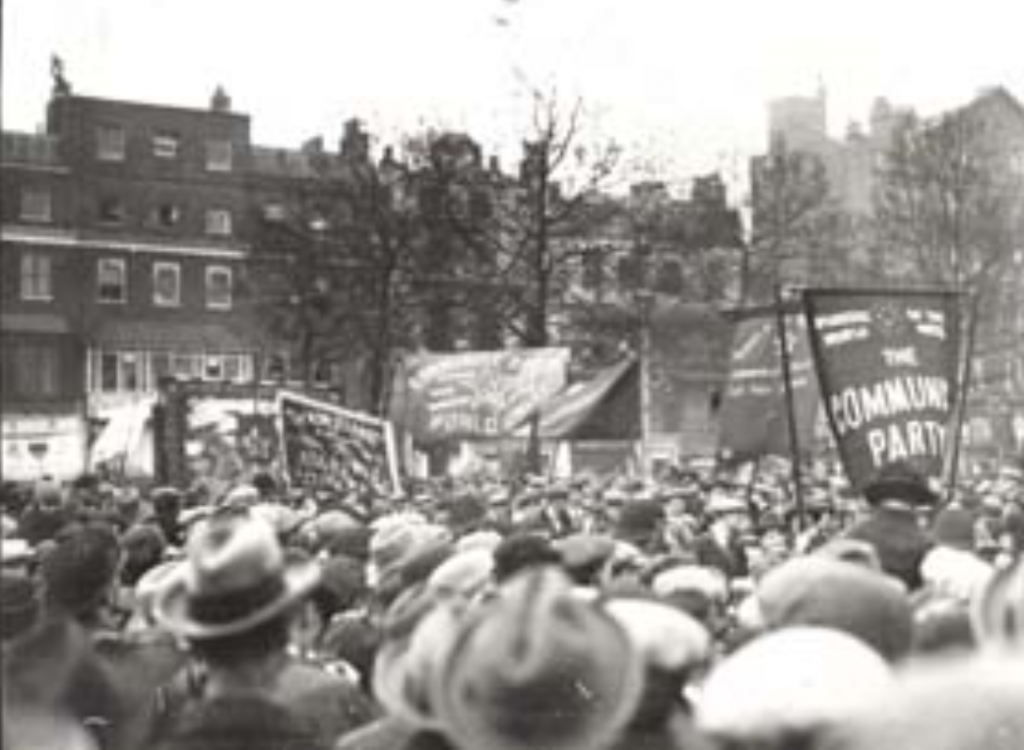
With the 9 days of the 1926 General Strike now over, it is important to look back at some of the lessons that can be learned from those events 100 years ago. Learning from our history is important, especially for young communists, to know the past successes and failures of our Communist Party and wider workers’ movement, and to inform our work today and tomorrow.
In his series on the history of the CPGB, James Klugmann dedicates an entire volume to the General Strike of 1926. Drawing on this detailed account, I will look at 3 key takeaways from those 9 days in May, and the months leading up. It is the role of great struggles like the General Strike to teach workers in hours what they would usually learn in years, and the workers that partook in the general strike learnt some important lessons in relation to the role of the state, the importance of unity, and the importance of communist leadership.
The role of the state
Lenin’s State and Revolution describes the state not as a neutral body, but a tool for the suppression of one class by another. The communists understood the class character of the state, and in a way so did the ruling class. It was the right of the labour movement who instead saw the state as a neutral body. The general strike proved Lenin’s ideas right and exposed many workers to the true class nature of the British state.
Acting pre-emptively, the government prepared to take on the workers, calling a state of emergency on April 30th – before the General Council of the TUC had made any official call for a general strike. This allowed the state to act in a repressive way towards the striking workers under the guise that they were threatening essential goods.
Even in the months before this, the state established the Organisation for the Maintenance of Supplies, which called for volunteers to help keep things running to get around any potential industrial action and working class organising. This organisation would be put at the disposal of various Volunteer Service Committees come the General Strike (History of the CPGB vol 2, p. 120). Such preparations come in stark contrast to the lack of readiness demonstrated by the labour movement’s leadership: the General Council did not even make preparations for a general strike until April 27th (p. 177-178).
Also before the Strike, the majority of the CPGB leadership were arrested, as were a number of Welsh miners. Then, starting on May 4th, the state of emergency was used to arrest many more Communists, including MP Shapurji Saklatvala, and other militant trade unionists. By the end of the Strike, over 1,000 communists had been arrested, mostly under different sections of the Emergency Powers Act (p. 164).
Such was the repression of the state in the face of a worker’s offensive, you could even find yourself arrested for possession of militant literature – such as the YCL’s own Young Striker bulletin (p. 167).
It wasn’t just the arrest of the movement’s most militant members – the state’s response was multifaceted. On Monday May 3rd, the Met Commissioner appealed for citizens under 45 years old to enrol as special constables. All army leave was stopped, and troops moved to important supply and industrial areas of the country.
The state also used the BBC and official state media, the British Gazette, to shape the narrative. These outlets refused to report the fact the Archbishop of Canterbury had proposed a settlement of the strike, with renewed subsidies and withdrawal of mineowners’ wage suggestions (p.123). They did, however, report on other Church figures who were far more critical of the workers.
The difference in understanding of the state between the communists and our allies on the one hand, and the right of the labour movement on the other, did not only have major implications for the strategy taken in 1926, but still exists today.
Those on the right of our movement still put forwards ideas around the neutrality of the state. Kier Starmer suggested the role of a Labour government would be to work as a middleman of compromise between workers and employers. A textbook example of the ‘neutral state’ notions of the state as above and separate from the class struggle. The capitalist state continues to undermine our movement and class just as it did during the General Strike, and the episode highlights the need for communists to smash the capitalist state and not simply work within it.
The importance of unity
It is clear from the events of 1926 that the communists could not do it alone. Their demands were carried further by allies in the wider labour movement.
One of the key calls of the communists and wider militants, including the National Minority Movement, was the call to establish Councils of Action. These would bring together representatives of the various trade unions in an area, including through the existing trade union councils, but also other militants and activists: including from the Young Communist League, some local Labour Party organisations, and other allies. One of the demands of the YCL was for a dedicated youth representative on these councils, though this was only achieved in some areas by the end of the strike.
The National Minority Movement (NMM), a broad organisation of the militant left with strong communist influence, held a Special Conference in March 1926. This resulted in the first calls for Councils of Action.
The Communist Party reiterated these demands in the months leading up to the Strike. It called on the Conference of Executive Committees, held April 29th to May 1st, to support Councils of Action, a Workers’ Defence Corps, and national and local agreements between unions or trade councils and cooperatives.
NMM Headquarters would outline the Workers Defence Corps on the evening of May 2, alongside calling again for Councils of Action (p. 114-15). The capitalist state had their Organisation for the Maintenance of Supplies, their military, their police and courts. The workers needed an organisation of their own to defend themselves.
One of the strengths of Councils of Action was that, in bringing representatives of various organisations together, “their united struggle is many times stronger than each organisation alone, even if acting in parallel” (p. 182).
The most effective strike committees and councils of actions began to represent “an embryo alternative centre of government… a type of ‘dual power’ ” (p. 159). Some areas of the country began to see the transfer of key responsibilities, such as transport, to the control and authority of the workers through these councils and committees (p.162).
Another key demand of the militant left, starting in the lead up to the strike, was for joint committees and deeper cooperation between trade union councils and the cooperatives. A part of this call was to ensure lines of supply from the relevant cooperatives, indicative of the way in which the burgeoning structures of working class democracy were beginning to try (and in some places succeed) to put infrastructure into worker control.
There was no official effort by the General Council or Labour leadership to gain unity with the cooperative movement, however. It was always the militants, including the Communists, who were consistently working for union-cooperative unity (p. 181).
The YCL’s own role in the strike was highlighted by Klugmann:
“In most areas young Communists enrolled in the most active sectors of the struggle – pickets, defence corps, communications, the semi-legal work of duplicating and distributing the bulletins of the Party and of the Councils of Action”
(page 170)
YCL slogans included:
- “United Front of the Young Workers”,
- “All Young Workers into the Strike”,
- And “Youth Representatives on the Councils of Action” (p. 170).
Many today talk about the need for ‘left unity’ to the point it has become cliché. Such unity is sometimes conceived as a coalition of various left-of-centre political parties. For others, it may mean capitulation to the reformist right of the movement, in the name of not ‘splitting the left’.
Yet if we look at the notion of unity for the Communists of the General Strike, the focus was not on unity for unity’s sake. There was not a capitulation to the right, not an abandonment of a militant left line, but concerted attempts over a number of months to win fellow workers to these core demands and shared strategy.
Yet at the same time, this steadfast militancy did not mean cutting oneself off from the broader movement in a sectarian way, refusing to cooperate on shared goals with those who, in other areas, may have been quite different.
We can see this in the year preceding the Strike. At Labour’s conference in Liverpool, said party voted to purge the communists from its ranks – something the communists fought hard against, along with some trades councils and local Labour Parties in certain areas. Far from disunity coming from the left, it came here from the right.
There are many lessons we can take from the Communist’s work with the National Minority Movement, Councils of Action, and changing relations with the Labour Party. The importance of a united front with trade unions at its core, bringing together allies around key demands not just at a national level, but at a grassroots level across the country.
We can clearly see continuity in some of these ideas from the broad left work of the 1920s CPGB to the United Front strategy upheld by today’s CPB. In many ways, the promotion of the People’s Assembly Against Austerity in the 2010s can be seen as an attempt to build broad grassroots unity around key demands, bringing local trade union organisations and other allies together.
The importance of communist leadership
Communists played an important role in preparing for and supporting the General Strike. However, the Party was ultimately limited in its size and influence, and unable to offer an alternative left leadership when the General Council gave up on the Strike. The lack of Communist leadership allowed the right-wing leadership of the TUC and the Labour party to betray the working-class offensive. It is the nature of reformists to preach “socialism” in times of calm, but rally to defend “the nation” in times of crisis (p. 176).
On May 11th, the General Council receive the “Samuel Memorandum”. This offered them no concessions beyond the vague suggestion of renewing subsidy for a time. Wages would still go down. It was not much different from the existing Royal Commission Report on the miners, and the government was clear Herbert Samuel, after whom the memorandum was named, was working on his own accord and the government were making no assurances (p. 125).
The evening of May 11th was the first time the miners would be represented in negotiations with Samuel. The miners subsequently held their own meeting and agreed they were unimpressed with the proposals, and any settlement on these would be on the authority of only the General Council, not the miners (p. 127).
On May 12th, the General Council visited the miners, who reaffirmed their resolution from the day before. The General Council then met the Prime Minister and most of Cabinet, unconditionally surrendering without even pressing the Samuel Memorandum (p. 128).
The General Council’s surrender on May 12th was an unnecessary capitulation. On the last day of the Strike, the number of Strikers was actually at its peak (p. 119). The momentum was growing if anything, certainly not shrinking. It was the Communist Party that appealed for the strike to continue and emergency conferences of Strike Committees and Councils of Action be held. A number of unions also told their members to stay on strike (p. 130).
One of the core dynamics in the fight for communist leadership is between a economist struggle that is limited just to improved wages and conditions, versus a revolutionary political struggle against the capitalist state. The masses in the General Strike supported the immediate demands, but most did not have the broader political consciousness. The episode highlights the need for the leading political role of the vanguard party to educate the working class beyond immediate economic demands.
The General Strike makes clear the need for the Communist Party and YCL to continue to grow. While we are not on the precipice of a new General Strike, we must be prepared for the next big battle in rebuilding the labour movement. We must be of a size and capacity to consistently put our ideas into practice and ultimately take on the capitalist state.
Join the YCL and Communist Party,
Remember our history,
Build the United Front against monopoly capitalism and war!
Philip English, is Editor of Challenge Magazine
For more on the General Strike, the lead up, and the aftermath, comrades are encouraged to read James Klugmann’s History of the Communist Party of Great Britain: The General Strike 1925-1926.
For more on the state, see Lenin’s The State and Revolution, available here on the Marxists Internet Archive.
For more on economism and the role of a communist vanguard, see Lenin’s What is to be Done?, available here, again on the MIA.