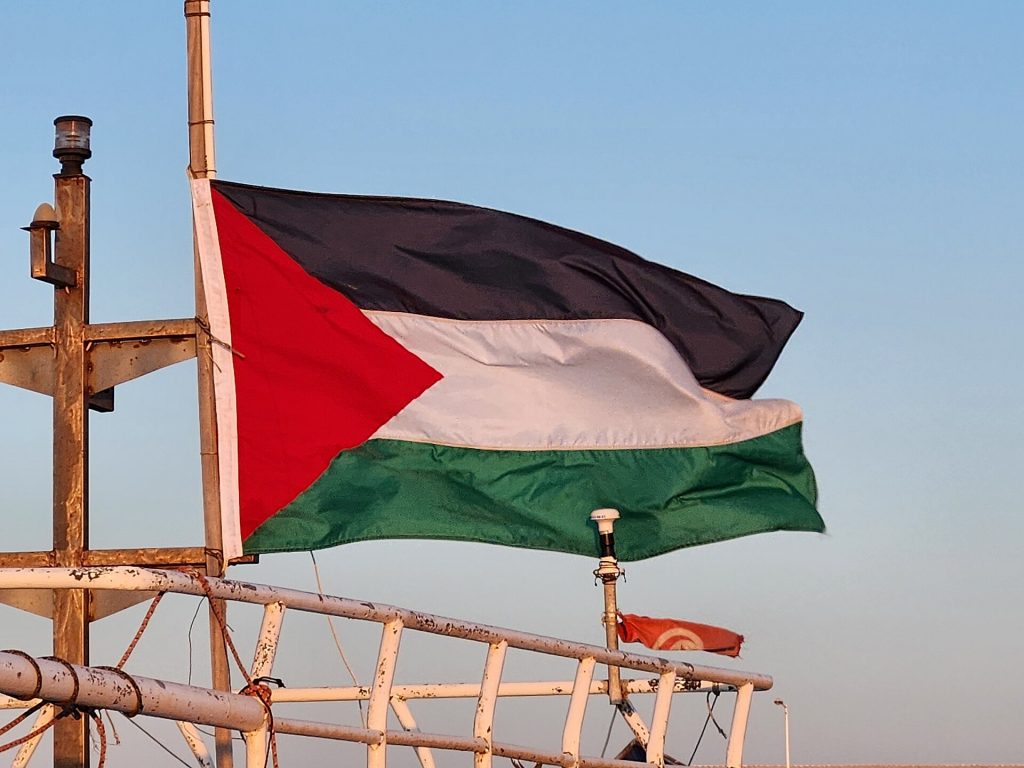
Masa Khawaja, a Palestinian activist and member of the leadership team for Youth Front for Palestine in Manchester speaks to Shaila Shobnam, YCL London Branch Member, about the mission of Youth Front for Palestine in mobilizing young people, and the challenges faced by Palestinian activists in the UK. She highlights the importance of political education, community outreach, and direct action, while also addressing the impact of the Gaza genocide on Palestinian communities abroad and the evolving portrayal of Palestinian activism in the British media.
SS: Could you briefly introduce yourself and your role within the Youth Front for Palestine in the UK?
MK: I am a Palestinian activist raised in England. I am part of the leadership team for the Youth Front for Palestine, specifically within the Manchester chapter. I have been involved with the organisation since November 2023.
What motivated you personally to become involved in Palestinian youth organising?
As a Palestinian raised in Britain, I attribute my attachment to my cultural heritage and identity to my parents, who constantly encouraged me and my siblings never to shy away from our roots.
I often look back with retrospective clarity on how I navigated my Palestinian identity in the West. It introduced a certain duality between the preservation of my heritage and the pressure of integration into the culture of a country which sold mine away; an imperialist power actively participating in, funding and profiting from the oppression and suffering of my people. Over the years, I recognised this is a battle which many whose ancestry originates from lands outside Britain resonate with.
Accordingly, as I became older and educated myself more on the symbiotic relationship between Britain and Israel, it felt increasingly necessary to involve myself in political activism not only to combat the ignorance around the topic of Palestine, to help sever material ties between Britain and Israel, but also to challenge and expose Britain’s biggest myth; representative democracy.
What are the main aims and priorities of the Youth Front for Palestine?
Our key aims are to mobilise the youth across our cities and channel commitment to the Palestinian struggle into concrete action, to end British complicity in Israel’s crimes, and to isolate the Zionist regime from our position in the belly of the beast.
We believe this is the best way to play our part in the fight for Palestine’s ultimate liberation. Since YFFP’s initial launch in 2022, inspired by the Unity Intifada of 2021, and with immeasurable help from our comrades within the Palestine movement, we have significantly contributed to, fought for and won several BDS victories for Palestine.
We are inspired the steadfastness of Palestinians, particularly over the course of the genocide in Gaza ongoing since October 2023, which has propelled Palestine into the hearts, minds, and in the context of our comrades who have taken direct action, the hands of many across the world, exposing Israel as the genocidal settler-colonial enterprise it is.
What kinds of activities or campaigns does your organisation run in the UK? How do you engage young people, especially students, in your work?
As an organisation, we approach activism with particular focus on targeted campaigns, political education and community outreach. Accordingly, we host public events and workshops, organise protests and BDS-focused actions such as office and event crashes (both locally and nationally), and organise local gatherings and activities to promote support for Palestine on a grassroots level. Current targets include Reebok, sponsor for the Israeli Football Association, and Booking.com, which lists 281 rentals across illegal Israeli settlements. Britain’s largest bank, HSBC, recently divested 95% of its investments in Israel’s biggest private arms manufacturer Elbit Systems due to sustained pressure from the Palestine movement, however it still holds 651 shares in Elbit to date.
We have a long history of mobilising within student spaces by way of exposing links between academic institutions and Israel and engaging students by way of internal workshops regarding such links. This then paves the way to action being taken against the academic institutions by utilising various tactics, some of which have been outlined above. YFFP has been able to contribute to student victories for Palestine, including MMU ceasing banking with Barclays in 2024, and expulsion of normalisation group ‘Solution Not Sides’ from a number of academic spaces.
Ongoing student campaigns including demands for the University of Manchester to cut ties with Israel’s Tel Aviv University, which established the “Dahiya Doctrine”, a military strategy employed by Israel against Palestinians to respond with “disproportionate” force and prioritise targeting civilian infrastructure over military targets.
What challenges do Palestinian youth organisers face in the UK? What misconceptions about Palestinian youth activism would you most like to correct?
Youth, as a demographic, are often made to feel disenfranchised and as though we cannot or should not make or contribute to long-standing, effective change. YFFP believes that there is power in recognising and tapping into the dynamism of younger generations. There are endless examples in revolutionary history to support this. The Palestinian youth, for instance, were key in ensuring the First Intifada developed into a sustained, popular uprising spanning in excess of 5 years.
Younger generations are often depicted as too “radical” or “extreme” in their efforts to effect systemic change, and as a result are sometimes ostracised by, or isolate themselves from, other demographics. This is contrary to what is more useful; youth being embedded within the popular cradle of mobilisation, afforded their own agency, and equipped with the tools to create, shape and maintain new ideas for wider movements.
In my experience, YFFP Manchester has been able thrive through collaboration with other organisations within the city’s coalition; organisations made up of members of different ages, backgrounds and cultures, and which have made a point of ensuring there is space for youth to operate and grow within the movement. The balanced combination of experience from older activists with the fresh perspectives of youth activists has helped lead to countless victories for Palestine in Manchester.
In your view, how is Palestinian activism portrayed in British media?
Mainstream media, particularly British media, is historically and continuously complicit in the bloodshed of Palestinians, even since prior to the Nakba in 1948. Palestinian activism has been either ignored or vilified. From a young age, I recall the depiction of Palestinians resisting against Israel as “terrorists”, and how martyred Palestinians were described as though they just so happened to have dropped dead of their own accord, as opposed to having been deliberately murdered by Israel. This form of warped and propagandised rhetoric curated specifically to normalise Israel’s actions and legitimise its presence has persisted even after the onset of the genocide in Gaza.
Over the last 2.5 years, I believe there has been a positive shift in the popular narrative surrounding Palestine and Palestinian activism in Britain. Terms such as genocide, ethnic cleansing, colonisation, settler-colonialism, and apartheid have become more frequently utilised in spaces where this was definitively not the case previously.
Direct action has been increasingly normalised and more widely accepted and encouraged. Public response to US/Israel’s attack on Iran and Israel’s bombardment of Lebanon is of stark contrast to the reaction to previous imperialist and expansionist endeavours. Additionally, and perhaps most crucially, there has been a significant increase in support for armed resistance by Palestinians in Occupied Palestine in popular discourse.
Plus, technology and virtual resources have never been more critical in people’s access to truth, engagement in meaningful activism, and thus, their ability to engage in the rejection of Israeli and Western propaganda. The knock-on effect of the shift in popular discourse is that mainstream media conglomerates have been increasingly pressured and held accountable for their blatant bias.
How has the current situation in Gaza affected Palestinian communities living in the UK?
I do not believe I can comment exhaustively or on behalf of all Palestinian communities living here, though I will try to summarise my thoughts based on my own interactions with Palestinians over the last 2.5 years.
First and foremost, these communities are made up of Palestinians with a myriad of personal histories, e.g. some having lived in different areas of Occupied Palestine during different periods of the occupation timeline, others never having been permitted to return to their homeland. This is an oversimplification, of course, of the intricacies of the Palestinian experience. There is no singular Palestinian experience, but there is a singular root cause of the Palestinian experience; Israel.
I have observed mixed and often bittersweet perspectives post-October 2023. On one level, there is the sentiment of October 7th having been a strong and powerful act of resistance against the Israeli regime. On another, there is the undeniable devastation of witnessing, or in some cases having experienced, the most brutal genocide in modern history. The disgust, horror and anger at Israel’s actions has blazed like inextinguishable fire behind the eyes of many Palestinians I have spoken with.
I have also sensed relief and vindication at the widespread exposure of Israel’s true character, false guise of democracy, and of its presence being the direct cause of destruction not only in Palestine, but in many countries around the world, particularly Iran and Lebanon at present. This recognition that Israel is nothing more than a self-serving settler-colonial power is a welcome relief after many years of Palestinians’ attempts to educate the masses having fallen on deaf ears. It is horrific and unforgivable that this exposure has been at the cost of Israel’s decimation of Gaza.
What role can young people in the UK play in supporting Palestinian human rights? How can young people who want to support your cause get involved?
Education, which should be followed by and underpin meaningful action. Understanding the Palestinian narrative and centring Palestinian voices is the first step to engaging properly with support for the Palestinian cause. A good starting point would be understanding the “Thawabet”, which are the red lines of Palestinian liberation movement; immovable, fixed principles which we must uphold in any action we take for Palestine. These include, but are not limited to, the right of return, the right to self-determination, and a free Palestine from the Jordan River to the Mediterranean Sea with Jerusalem as her capital.
The correct narrative can and will shape the integrity and efficiency of mobilisation efforts. We must take action, but we must understand why we take action. Likewise, knowledge must be combined with meaningful engagement. Martyred Palestinian revolutionary Basil Al-Araj termed this as the “engaged intellectual”. Specifically, he stated “If you want to be an intellectual, you have to be engaged… if you don’t want to be engaged – if you don’t want to confront oppression – your role as an intellectual is pointless.”
Meaningful action looks different here in Britain than it does in Palestine. We are not directly confronting Israel as Palestinians do under occupation. However, we can help to weaken the oppressor, primarily by breaking its financial links to Britain’s economy and rejecting normalisation of both its crimes and its presence in this world.
Young people who wish to support the cause through YFFP specifically can keep up to date on our social media pages which reflect recent developments and how to get involved. Otherwise, if there are no organisations operating within people’s local areas, or the structure and narrative of existing organisations make it difficult to mobilise effectively for Palestine, my best advice is sometimes we have to spark change ourselves as opposed to waiting for an opportunity to present itself, or be presented to us. You would be surprised as to what a group of 5-10 likeminded and politically grounded individuals can do. The simplest path: locate a target linked to Israel, outline a clear demand, and mobilise around that target regularly.
What are Youth Front for Palestine’s goals for the next few years?
To win further victories for Palestine, to strengthen the framework of engaging youth in Britain to mobilise for Palestine and to continue the expansion of community outreach.
Antisemitism is a serious concern in the UK. How does your organisation actively challenge antisemitism and ensure activism against Israel Government never becomes hostile toward Jewish people?
As an organisation, our activism against Israel is focused on amplifying Palestinian voices and narrative, fortifying and winning targeted campaigns against Israel, and educating the masses on Israel’s occupation of Palestine. We reject the weaponisation of claims of antisemitism as a method of distracting from, repressing, censoring and delegitimising the Palestinian cause; a cause centred on pursuing the freedom of an oppressed, indigenous population.
Though it cannot be denied that there are genuine cases of antisemitism within the broad framework of discourse and discussion around Israel’s occupation of Palestine, it must be recognised that the Zionist ideology, the creation of Israel and the sustained and deliberate conflation of anti-Zionism with antisemitism by Zionists have in and of themselves fueled anti-Jewish rhetoric.
Palestinians of all faiths and non-faiths, both in Palestine and across the diaspora, have spent decades being forced to justify themselves and their fight for liberation due to manipulated use of the term “antisemitism”. This term has been used in strategically reactionary ways to deflect focus and criticism from Israel, and allow it to act with impunity when committing the horrors, it has inflicted against Palestinians. It also links to my response on biased mainstream media and how it has assisted in censoring Palestinians by way of this tactic. We have seen this shamelessly done even during the genocide in Gaza, over the course of which Israel has slaughtered what is now estimated to be hundreds of thousands of Palestinians.
Palestinians have borne the brunt of the above, despite our narrative being exclusively rooted in anti-racism, anti-colonialism and anti-imperialism. YFFP does not engage in what we consider to be disingenuous discourse which detracts from our central aims, and we do not tokenise Jewish members of the Palestine movement to “prove” we are not antisemitic.
It was not Palestinians who deliberately and, with calculated intent, chose to place the Star of David on the flags and uniforms of a settler-colonial entity and its military forces. It is not Palestinians who denounce Jewish anti-Zionists as “self-hating” for engaging in pro-Palestine activism. It is not Palestinians who falsely claim the atrocities they commit, including ethnic cleansing and genocide, are justified by a political, racist, Jewish supremacist ideology. Thus, it is our position that it is not the duty of Palestinians to bear the responsibility for anti-Jewish narrative in the context of Israel. The focal point of our activism is clear.
On a personal level, as a Palestinian what keeps you motivated despite the challenges of organising?
I am a Palestinian. I hail from a land of sage, simsim and subjugation. I am the child of Palestinians, who are the children of Palestinians, who are the ancestors of generational defiance. We do not succumb and we consider despair to be a tool of the oppressor. I take inspiration from the resilience of Palestinians, be it those under siege, behind the walls of Israeli prison cells, resisting genocide, or defying their oppressor with rocks in hand and steeled will. I believe that Palestinian sacrifice will never be in vain, and the freedom of Palestine is an inevitability.
Masa Khawaja, is a member of the Youth Front for Palestine
Shaila Shobnam, is a member of the YCL’s London Branch