[First delivered by Matthew Miller at the May 2026 meeting of the YCL Central Committee meeting, 30th-31st May]
There is a staggering figure of one million NEETs (Not in Education, Employment or Training) in Britain. That is one million people who are currently looking for a purpose who can be taken up. Although, with the lack of class consciousness in Britain, NEETs can also succumb to the trappings of the far right. This is the consequence of one million people who are more likely than not depoliticised and not involved in any wider political or community project.
The rise of artificial intelligence exacerbates these figures as well. AI is linked to young people not having jobs as AI is taking lower level roles that young people would generally do as entry level jobs.
NEETs can also be linked to the fact that younger generations have lost faith in our institutions. They can pose the question to themselves of whether it is worth putting in the effort towards school, towards university and apprenticeships, when those are manifestly not offering good quality services and education and when their wages are not enough to live on in many cases.
NEETs look at a wider economic malaise, as who is going to invest in their workforce when there’s a diminishing profit margin. This highlights the need for investment in apprentices that needs to be part of an economic strategy. The employment figure doesn’t represent the quality of jobs, wages and regularity of shifts.
The British Government offers increased militarisation for its populace as an answer to the staggering amount of people who are out of work. That is why there are bus stops and billboards littered with advertisements for the army. Instead of quality apprenticeships, there are defence excellence colleges that seek to poach young people and recruit them into the military industrial complex that Britain is willing to invest in at the cost of public services.
Therefore, the economic outlook of Britain that leads to NEETs can also be tied to the bloated defence budget. This is why the Alternative Defence Review is vital for making the case of peace to people in Britain. There is a clear need for meaningful reindustrialisation and job creation not tied to militarism.
May Local Elections
Shortly after May Day, local elections were held in England, Scotland and Wales. Unsurprisingly, there was a significant wipeout for the Labour Party in all of these areas. People are rightfully angry at the lack of progress displayed by a government elected with a parliamentary majority. Therefore, Reform, which has been chosen by the financial elite as the new vehicle for neoliberalism and austerity, has dethroned Labour as the main agent of liberalism. In Wales, a century of Welsh Labour rule has been destroyed by the collective frustration towards the ineffective management of Welsh Labour. The oft-repeated mythos of ‘clear red water’ between Welsh Labour and England was not enough to keep voters at bay this time around. Although, the defeat of Welsh Labour has taken the form of Plaid Cymru, the nationalist, pro-independence party that differs from the SNP in its structure and political alignment, though it is yet to be seen how that develops in the form of a first minister. The valleys have also had significant Reform gains as well. In 2024, when canvassing for the Communist Party in Abertillery, some people remarked at their doorsteps that they were torn between voting for us or Reform- but the clear message was ‘anyone but them two’ which at the time was Conservative or Labour.
People who are insulated from the crises of 21st century Britain might be arrogantly asking “How could this happen?” or “Why would anyone vote for Reform?” with the same dumbstruck expression or smug superiority that they donned when Brexit succeeded or when Corbyn was defeated in 2019.
Reform has cleverly manoeuvred themselves to appear as a party that promises mild, social-democratic economic policies and immigration control while maintaining the socially, conservative, Christian-adjacent morality and values that that still lie at the core of the population of Britain outside of the various metropoles. Unfortunately, the reality is that they harbour an economic vision of Britain that would perpetuate the neoliberal death spiral that we’ve been living in for almost half a century.
An interesting case study is that the other week while visiting Hampshire I noticed a pamphlet from a local Reform candidate. The candidate was a woman who spent the majority of her time volunteering and was a TA at the local secondary school. The demands on the front of the pamphlet were indistinguishable from a left-wing Labour or Green candidate. Most parties would jump on any opportunity to have her as a candidate. So why did this woman choose Reform? Well – why not? The Labour party offers the bland, dismissive hand of the professional managerial class and the Green’s messaging around open borders, net zero, the EU and their general optics are anathema to people who live in de-industrialised Britain. As for other parties, like ours, while we do lack the power and funding, the more crucial aspect that we can look at that we seem to be afraid to articulate our policies on immigration and progressive patriotism. Why? Is it because we are afraid? Are we afraid of attracting regular citizens who are proud of their nation? If so, then we need to analyse why that is the case.
However, across Britain YCL cadres helped the party in their local election campaigns, with a particularly strong showing in Edinburgh. We utilised our literature that targets Reform’s destructive, Thatcherite economic vision, which cuts to the heart of what affects the working class. Focusing on labelling them as fascist, racist or homophobic is a dead end – we would be another voice in the din of opposition that the working class has tuned out. Now is the time to build upon that campaigning work into a lasting presence within those respective communities.
May Day
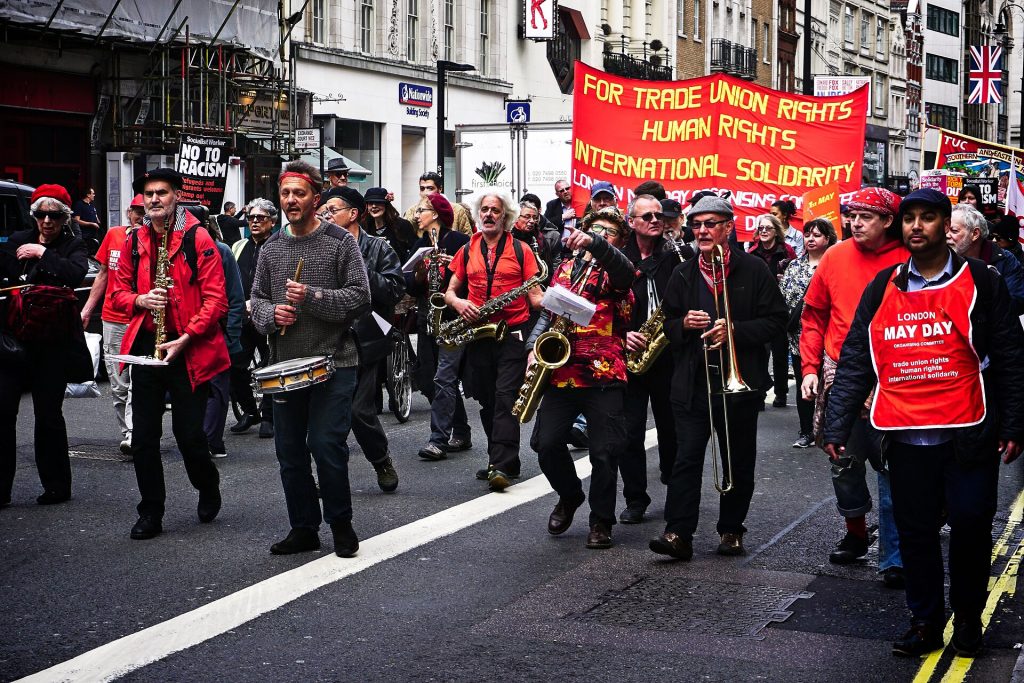
Focusing on May Day itself, it was a historic one that marks 100 years since the 1926 general strike. Across the country trade unions and the broad, progressive anti war and anti-monopoly movement mobilised to march and commemorate this anniversary and to celebrate the power of the working class. Although, there is a healthy scepticism that these mobilisations should be greeted with. Mobilisations such as May Day reflect our movement and the people that populate it. There is a risk that these days tip into practice in self-congratulation and mythologisation that reflects a complacent tendency in Socialist movements. For example, do we ask ourselves the questions of ‘How many trade unions are on this march?’, ‘Who is making up the people in this march?’ and ‘How are they presenting themselves?’. In London and elsewhere, it is clear to see that to the public the march is one that is made out of the hardcore, activist base of the Socialist movement. the YCL and the Party need to ask the question of who are we pursuing when building our base, the already indoctrinated and involved or the workers who are depoliticised and deeply affected by the changing conditions of the world? It’s a question that branches and committees should pose to themselves.
What we can be proud of is that our May Day message attempts to break the pattern of the dull, apocalyptic messaging of other parties that can be easily tuned out – which is the fact that as members of the Young Communist League, it is powerful and galvanising to imagine being in power, and building towards it rather than casting ourselves as victims or a collective of oppressed peoples. And that is what we tried to show as a mass movement on that important day.