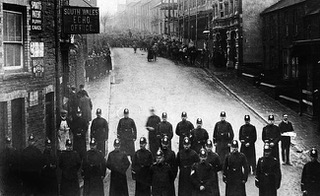
It’s 11 June 1936, the British Union of Fascists (BUF) are yet to make inroads in Wales, so Tommy Moran, a former Newcastle miner, is equipped with a van and a small group of Blackshirts to hold a rally to spread their fascist and antisemitic message with the ambition of increasing their membership. Moran, being a former miner, is an ideal candidate to connect with miners in the Rhondda valleys. They keep the location secret until the morning where they use their van and speakers to announce De Winton Field in Tonypandy will be the location for the rally. Quite a bold choice considering that the area has a strong reputation for socialist, trade unionist and communist organising. “Little Moscow” (Maerdy) is only up the road, and many locals had been involved in the Tonypandy Riots in 1910-11 which showed their militant resistance once before.
The rally is set to start, and the Blackshirts are met with a crowd of around 6,000 people. Of course, this wasn’t quite the crowd they are expecting because it is made up of socialists, communists, trade unionists, miners, anti-fascists and local residents which vastly outnumber the fascist organisers. Annie Powell, who became the first communist mayor in Britain, said, “not even one Welsh sheep will hear the Mosley message.” The locals give Mosley’s boys a hostile reception and only 30 minutes later the BUF, with full protection from the police, are sent packing following a humiliating defeat. The South Wales Miners’ Federation, more commonly known as “The Fed”, play a pivotal role with seven working pits in the immediate vicinity of Tonypandy. There are 37 arrests made, and a total of 137 counts including riot, unlawful assembly and disturbing a public meeting.
Young people played important roles in the Battle of De Winton Field with Harry Dobson and William Bevan being sent to prison for their involvement in ensuring the BUF never organised in Wales again. Harry Dobson, a miner, member of the Fed and the Communist Party’s first words on his release in 1937 were “how do I get to Spain?” He joined the International Brigades and tragically lost his life on 3 August 1938 whilst fighting against the fascist Franco dictatorship.
What made the BUF’s rally in De Winton Field different to other areas is that its primary goal was not about trying to terrorise a Jewish community, as in Cable Street, but it was a recruitment drive to try and get a hold of the anti-establishment anger in the Rhondda Valleys. Only a decade earlier in 1927, The National Hunger March saw workers from Tonypandy joining to protest against severe poverty. This was a community looking for change. There was a clear alternative for the people of Tonypandy, and this was the idea of socialism.
So what lessons can we take from this event 90 years on?
Firstly, we have to look at the change of the political landscape. Since 1922 Labour have been dominant in Wales. Last month we saw Welsh Labour’s 27 years of uninterrupted rule since the Senedd was founded come tumbling down and in its place saw Plaid Cymru take the most seats with 43 out of 96, with Reform UK making huge gains to become the official opposition with 34 seats. Labour only managed to save a handful of MSs with a measly 9 seats. With Plaid Cymru pitched as the centre left party, and Reform UK as far right, what do the people of Wales want? They want change.
In 1936, Tonypandy was able to see off the BUF, so why have so many turned to Reform UK in 2026? The anti-establishment anger is still there, however with the closure of the pits hundreds of local jobs have gone. As a result, local employment is harder to come by so the valleys have become commuter towns with higher levels of unemployment. No doubt Thatcher declaring “there is no such thing as society” in the 80’s made clear her intentions to smash any ideas of communities looking out for each other. Then came the decline in union density, which played a key role in local community organisation start to lose strength. These factors mean that there isn’t a strong base for community organising as it was in 1936 to see off threats and tactics to divide our communities and the working class. Voter turnout in UK General Elections has continued to decline and in the recent Senedd Elections, whilst overall it surpassed 50% for the first time in history, in the Afan Ogwr Rhondda constituency, where Tonypandy is situated, the turnout was only 45% showing voter apathy was the real winner.
As communists, the lessons we must take from the Battle of De Winton Field is the importance of organising in trade unions and the local community. We must build the united front and we must intensify our efforts to educate and raise class consciousness to win them over to our ideas and achieve Britain’s Road to Socialism. Without building the working class movement, there will be no movement to lead.
Twm Draper, is a member of the YCL’s Central Committee and Cymru Branch