
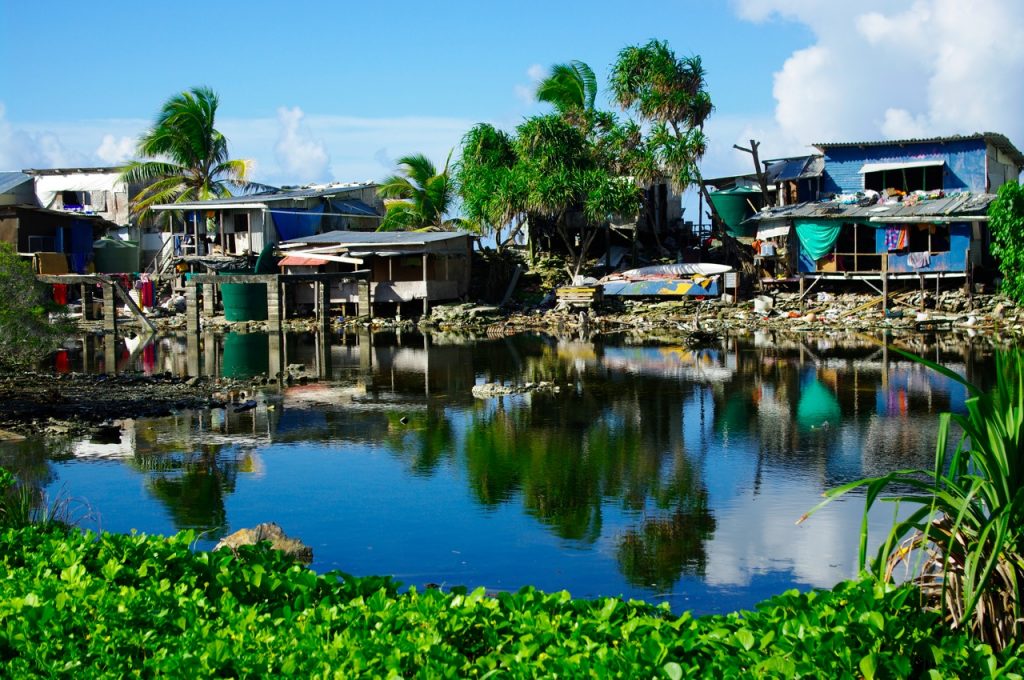
Tuvalu is a Polynesian island nation nearly as far away from Britain as one can reach, a place few Britons will likely think of aside from perhaps as a holiday destination. Yet Britain and Tuvalu share a king, and the use of polluting technologies including artificial intelligence in this country have dire consequences on Tuvalu and the world, as well as creating a chance for imperialism to stick its foot into the door, as it were.
The Australia-Tuvalu Falepili Union Treaty was signed in November 2023 and entered force in August 2024 as the first bilateral agreement on “climate mobility”, creating a pathway for Tuvaluans to apply for permanent residency in Australia on the basis of the impact of climate change on Tuvalu. Initial provisions are for 280 visas per year, with an option to change this following agreement between Australia and Tuvalu.[1] It should be noted that this is not free, with an entry for the 2025 ballot costing A$25.00 (equivalent to £11.93).[2]
An interesting point to note is one of the Tuvaluan constitutional amendments from October 2023, which states that “the State of Tuvalu within its historical, cultural, and legal framework shall remain in perpetuity in the future, notwithstanding the impacts of climate change or other causes resulting in loss to the physical territory of Tuvalu.”[3]
There are serious questions to be had of the scheme resulting in a massive population drain further exacerbating the national decline even before the coming climate catastrophe; indeed, in 2025, 1,125 applications for 4,052 Tuvaluan citizens out of a total population of 10,643 were submitted.[4]
Furthermore, there was no public consultation regarding the treaty, with some parliamentarians considering it to be an attempt to cement Tuvalu as an Australian strategic stronghold and opposition leader Enele Sopoaga even including the scrapping of the treaty in their campaign during the 2024 general elections.[5] Indeed, the treaty includes an article on “Cooperation for security and stability”, which states that Australia will assist Tuvalu against “a major natural disaster; a public health emergency of international concern; military aggression against Tuvalu”,[6] with Tuvalu also agreeing not to enter defence agreements with any other countries without Australian approval.[7] Considering the recent diplomatic spats concerning the Solomon Islands and China, it is quite clear that this is part of a further intensification of the drive towards a new Cold War.
There is also the contradiction of Australia accepting Tuvaluan climate refugees but deporting other migrants to Nauru. In 2001, the Howard government announced the “Pacific Solution”, offloading asylum seekers to detention centres in Pacific island nations.
This was supplemented by the Regional Resettlement Arrangement between Australia and Papua New Guinea announced in 2013 which allowed for even legitimate refugees to be settled in Papua New Guinea.[8] Furthermore, a deal signed between Australia and Nauru in early 2025 allowed for the deportation of foreign detainees which could not be deported back to their home countries for fear of persecution to Nauru instead, with these people to be given a 30-year visa allowing them to work and reside in Nauru. The first of these were exiled on 24 October 2025, triggering an upfront payment of A$408 million.[9]
Nauru itself was ravaged by the exploitation of its phosphate reserves by Australia, Britain, and New Zealand, and when granted independence from Australia in 1968 these phosphate resources had been all but expended. In fact, similar to the present situation with Tuvalu, there were discussions in 1963 and 1970 of transporting the entire population to Queensland due to the environmental damage that had left much of the landscape unfit for agriculture or construction.[10] It is clearly evident that the scars Nauru bears from a long history of exploitation by Australia are deep.
The immigration detention centre has since become the overwhelming majority of Nauru’s economy, with A$200 million or two-thirds of total revenue in 2024 coming from the facility.[11] With this, Australia has not only trapped Nauru into a relationship of reliance, but also forced Nauru into becoming a collaborator in an inhumane anti-refugee policy.
The cause of environmentalism, therefore, is inextricably linked with anti-racism.
Socialist Cooperation on Solar Power
On 6 January 2026, U.S. President Donald Trump signed Executive Order 14380 “Addressing Threats to the United States by the Government of Cuba”, the beginning of an oil blockade that continues today. In addition, the United States has revoked the visas of officials from countries hosting Cuban doctors, pressuring them to end medical cooperation against their own people’s interests.[12] The consequences of the energy blockade have been dire, with approximately 5 million Cubans with chronic illnesses facing disrupted medications or treatments, and 16,000 cancer patients requiring radiotherapy and another 12,400 undergoing chemotherapy having their treatments disrupted due to the unavailability of electricity-powered equipment during blackouts. A four-day work week has also been imposed for state entities, and public transport has been severely reduced.[13]
In contrast China has committed to building 92 solar parks by 2028 with combined capacity of approximately 2,000 megawatts, and by February 2026, China had assisted in adding 49 solar parks with more than 1,000 megawatts capacity to the Cuban energy grid, some within just 35 days of equipment arriving. For each megawatt produced in Cuba through solar energy, 18,000 tonnes of fuel need not be imported, and China’s construction will ultimately be equivalent to Cuba’s entire current fossil fuel generation capacity.[14]
This solar race is joined not just at the national level but by also ordinary Cubans and local facilities. China has donated 10,000 photovoltaic systems to isolated rural homes, maternity wars, and health clinics, and an additional 5,000 have been installed in health centres across 168 municipalities, each comprising panels, inverters and storage batteries. These initiatives have been described by the head of Cuba’s Electrical Union as lifesaving and have a direct effect on people’s lives, allowing families to run their daily appliances and reducing rural-to-urban migration driven by energy poverty.[15]
As stated by Maribel Aponte-Garcia, an economist and professor at the University of Puerto Rico, Rio Piedras Campus, “Chinese investment in solar energy in Cuba is a joint commitment to energy sovereignty, South-South cooperation, and the multipolar reconfiguration of global trade and logistics”.[16] In a similar vein, Carlos Martinez stated that China “is emerging as the major trading partner of the vast majority of global South nations; has become the world’s only renewable energy superpower; and consistently demonstrates its commitment to peace, international law and global prosperity.”[17] In the darkness of imperialism’s attempt to choke out a people’s hard fought sovereignty and independence, the fraternal bonds of the socialist community and its material solidarity are a beacon of hope to those around the world who look towards a better future.
The Environment, Imperialism and War
The human casualties of conflict are tragedy enough, but it is also important to recognise the environmental impact of war. Counting only direct emissions from fuel combustion and purchased electricity and excluding indirect emissions from employee travel, waste disposal, and the supply chain, as an institution, the U.S. military stands as the largest emitter of greenhouse gases in the world, and if it were a country it would rank 47th globally, higher than Sweden and Portugal.[18]
In Gaza, Israel’s campaign of destruction resulted in some 37-50 million tonnes of debris including asbestos, heavy metals, and unexploded ordnance with devastating impacts on soil and groundwater. Fires exacerbated the situation by bringing up dust and debris as aerial pollutants.[19]
Turning to Europe, estimates of the release of methane from the explosion of the Nord Stream pipeline, ranging from 100,000 to 200,000 tonnes, exceed that of the Aliso Canyon blowout (the largest gas leak in the U.S.). Taking into account that methane is considered 30 times more damaging as a greenhouse gas than carbon dioxide, that is roughly equivalent to 32% of the annual carbon dioxide emissions of Denmark or to 1.3 million cars being driven over the course of a year.[20] Similarly, a 2020 report found that the British military-industrial sector stood ahead of 60 countries in its carbon emissions.[21]
This is not even to speak of the follow-on effects, such as governments opting to put funding towards military spending rather than climate change mitigation and adaptation; in the 2024 Labour Budget, at least £58 billion was allocated to the former compared with just £11.3 billion for the latter.[22] No matter the military industrial complex’s attempts to greenwash its activities with “Militarised Environmental Technologies”,[23] as Marxist-Leninists we recognise the moral and economic bankruptcy of these programmes.
Beyond greenhouse gas emissions, imperialism demands the very land and its environmental resources be subjugated to its authority.
During Dutch rule in Indonesia, the policy of extirpatie (extirpation) was enacted in 1652 which called for all clove trees not under ownership of the Dutch East India Company (VOC) to be uprooted and burned, with the punishment for growing, stealing or possessing clove plants without permission being death. By chance, one tree called Afo survived, with a French man taking seedlings from it and breaking the Dutch monopoly on cloves.[24]
France developed a similar scheme in state ownership of trees in Africa. In July 1900, the first forestry legislation for French West Africa was enacted, placing forests under French colonial state control, limiting forest clearing and cutting of “high value” species to be at the permission of the Commandant of each Cercle, creating permits and concessions, and establishing a system of punishment for violations of the law. Fundamentally, the French state then controlled forest resources considered to be of commercial value, while rural indigenous populations were given the remainder, though the latter’s rights to these resources could be rescinded if they were subsequently deemed of interest.[25] Indeed, a paper on the privatisation of forests in Côte d’Ivoire specifically laid out that: “Deforestation has always been a concern for political authorities. In the colonial era, the colonial administration was already concerned about deforestation in West Africa, and especially in Côte d’Ivoire. Forests had to be preserved not for local social or ecological reasons but to guarantee the long-term economic exploitation of the colonized territories.”[26] A further class-based division came into play in that commercial exploitation permits were sold to the highest bidder, with a minimum sale price fixed by the Lieutenant-Governor.[27]
In an insidious parody of historical imperialist practices, the genocidal apartheid state of Israel continues in the tradition of colonial attempts to bring the trees to heel. Mirroring the exterpatie of the Dutch in Indonesia, since 1967 Israeli forces have uprooted over 800,000 olive trees, replaced with over 250 million mainly invasive trees (pines and eucalyptus) since 1948, destroying an important economic and food resource for Palestinians. While attempting to cover over ethnically cleansed Palestinian villages, the new trees have increased water scarcity, pose a danger to local wildlife due to their toxicity, and are highly flammable as a result of their resin.[28] The fact that these forestry actions are not for environmental reasons is further cemented when considering the comments of Dominick DellaSala (Chief Scientist and President of the Geos Institute in Ashland, Oregon, and President of the North American section of the Society for Conservation Biology), who has described plantations and tree farms as “fake forests”, asserting that they “a poor substitute for real forests particularly old-growth stands – particularly old-growth stands. They are prone to intense forest fires, are climate polluters, and are biologically ‘ecosystems.’”[29]
Indeed, forest fires have been a perennial headache in the regions of Israeli forestry. Regarding the 2025 fires, Ronnie Kasrils, an anti-apartheid activist, former minister for intelligence services of South Africa, and a Jew himself, said:
“This is an apt symbol for the smoldering toxins in a failing Zionist system turning to ash. The genocidal apartheid state requests the West for help to fight the fires, while, without any scruples whatsoever, its military burns children and adults alive in Gaza, the West Bank and Lebanon, courtesy of United States, British, French and German bombs, to the cheers of most Israelis and the Zionist international.”
[…]
“The burning settler forests of Israel, a colonial blot on the stolen landscape, take me back to the opening of the armed struggle in South Africa in 1961, when we set alight the sugar cane and wattle plantations of colonial settlers who, like the Israelis, had dispossessed the indigenous people and stolen the land.”[30]
Despite reaping the whirlwind of their own actions, Israeli forces continued to escalate their ecocide. In the midst of the war in Gaza, by early 2024, Israeli aggression had destroyed 38% of Gaza’s farmland, and by January 2025 a full 80% of Gaza’s tree cover was gone.[31]
Additionally, for all their claims of being autochthonous, 66% of Israeli Jews in areas where olive tree density is high are hypersensitive to olive pollen (29% where tree density is low), while among the Arab population hypersensitivity is limited to 14% even where there is high tree density.[32] Evidently, the very land itself joins the fight against colonialism.
The cause of environmentalism, therefore, is inextricably linked with anti-imperialism.
The Environment and the Economy
A common argument used right-wing forces is to pit environmentalism against the economy, a line of reasoning that is as devoid of common sense as these pundits are divorced from the interests of the working class.
In Britain, we are familiar with the disastrous impact of the shutting down of mines during the Thatcherite era, in which coal miners were left to fend for themselves without jobs or training, with terrible consequences for working-class families and communities alike. A clear alternative can be seen in China, which established the Special Fund for Excess Capacity Reduction in 2016 as part of a programme to handle lay-offs and reemployment in the coal and steel industry, with the Ministry of Finance putting 100 billion yuan (equivalent to US$15.33 billion) towards subsidising local governments and state-owned enterprises in reducing coal and steel overcapacity, with parameters including the number of laid-off workers that must be resettled and the difficulty of doing so.[33] As an example of the success of these policies, an estimated 99.8% of the workforce of Shanxi province that were made redundant following coal and steel lay-offs were successfully re-employed, and across 28 provinces, over 726,000 workers found new employment in 2016.[34] Furthermore, China’s workforce involved in the ecological and environmental protection sector stood at over 3.4 million by the end of 2024, and it is estimated that China’s proactive green transformation could create as many as 38 million jobs by 2050. Aspects of this work, such as on-site surveys of wind and solar bases, also bring white-collar workers into remote regions,[35] which allows workers to see the fruits of their labour for themselves. Similarly, the State Council Guidance for the period 2025–2027, which aims to train 30 million workers, also includes Agriculture and Rural Revitalisation as one of its six fronts of training, with a focus on high-quality farmer cultivation, “rural craftsman” programs, and agricultural technology training to keep rural labour relevant.[36] Parallels can be drawn here with the policies laid out in Britain’s road to socialism, which states that:
“Support for local communities in the countryside will also need specific measures to provide well-paid employment in farming, forestry, conservation and tertiary industries including light engineering, manufacturing and construction. Sustainable agriculture should be expanded with adequate state support for investment and environmentally beneficial improvement, but subsidies ended to big landowners and agribusiness. Britain should aim to become more self-sufficient in food production, with support for small and tenant farmers, including incentives for cooperative initiatives.”[37]
It is also worth mentioning that in its final years, the German Democratic Republic also led the way for environmental protection in the household, only for this to be strangled by the return of capitalism in the counterrevolution. The VEB Scharfenstein enterprise, in collaboration with Greenpeace and the Dortmund Hygiene Institute, designed the first refrigerator which did not make use of chlorofluorocarbon or hydrofluorocarbon, chemicals that damage the ozone layer. This was part of an attempt in 1992 to maintain the company’s survival and maintain the livelihoods of its 630 workers (already down from 5,500). The new refrigerators used propane and butane for cooling instead, with 650 million produced, and were a serious threat to Western markets. The technology had also not been patented at the insistence of Greenpeace to allow it to be quickly replicated. In response, a massive media campaign falsely claimed that the refrigerators were dangerous and environmentally damaging, forcing the company (now named Foron) out of business and relegating it to be purchased by a Dutch company following bankruptcy in 1996. Despite this, the Foron design is now recognised as a standard for environmentally-friendly refrigerator manufacturing.[38]
The cause of environmentalism, therefore, is inextricably linked with anti-capitalism.
Taken together, it is clear that the goals of environmentalism cannot be achieved without socialism, and without environmentalism we cannot achieve socialism on a dead world. Either capitalism becomes extinct, or we do. Indeed, Britain’s road to socialism explicitly states that “Global warming, climate change, agricultural failure, rising sea levels and economic devastation are the direct result of capitalism’s inability to disengage from fossil fuels.”[39] Looking back to Tuvalu, incumbent prime minister Feleti Teo has doubled down on maintaining official diplomatic recognition of the Taiwan authorities rather than the People’s Republic of China, and while acknowledging the lack of transparency in the Australia-Tuvalu Falepili Union Treaty has continued to express support for its “broad principles and objectives”.[40]
The revolution may not be televised, but a nation’s annihilation will be digitised.
Tuvalu mo te Atua.
Ethan Chan, is the YCL’s International Officer
[1] Liliana Gamboa and Debbra Goh, “Australia-Tuvalu Falepili Union: The First Bilateral Climate Mobility Treaty,” Carnegie Endowment for International Peace, September 9, 2025, https://carnegieendowment.org/research/2025/09/australia-tuvalu-falepili-union-the-first-bilateral-climate-mobility-treaty?lang=en.
[2] Tabby Wilson, “A third of Pacific island nation applies for Australian climate change visa,” BBC News, June 27, 2025, https://www.bbc.co.uk/news/articles/cvg9750vvwxo.
[3] Gamboa and Goh, “Australia-Tuvalu Falepili Union”.
[4] Wilson, “A third of Pacific island nation.”
[5] Gamboa and Goh, “Australia-Tuvalu Falepili Union”.
[6] Australia-Tuvalu Falepili Union treaty, Aus.-Tuv., November 9, 2023, https://www.dfat.gov.au/geo/tuvalu/australia-tuvalu-falepili-union-treaty/treaty-text-falepili-union.
[7] Tiffanie Turnball, “Australia offers climate refuge to Tuvalu citizens,” BBC News, November 10, 2023, https://www.bbc.co.uk/news/world-australia-67340907.
[8] Memorandum of Understanding between the Government of the Independent State of Papua New Guinea and the Government of Australia, relating to the transfer to, and assessment and settlement in, Papua New Guinea of certain persons, and related issues, Aus.-PNG., August 6, 2013, https://www.dfat.gov.au/geo/papua-new-guinea/memorandum-of-understanding-between-the-government-of-the-independent-state-of-papua-new-guinea-and-the-government-of-austr.
[9] Tiffany Wertheimer, “Australia deports first foreign detainees to Nauru in controversial deal,” BBC News, October 28, 2025, https://www.bbc.co.uk/news/articles/cvgdp58vkkpo.
[10] Anne Davies and Ben Doherty, “Corruption, incompetence and a musical: Nauru’s cursed history,” The Guardian, September 3, 2018, https://www.theguardian.com/world/2018/sep/04/corruption-incompetence-and-a-musical-naurus-riches-to-rags-tale.
[11] Kirsty Needham, “Australia agrees to pay Pacific nation of Nauru $1.62 billion to house deportees,” Reuters, September 3, 2025, https://www.reuters.com/world/asia-pacific/australia-agrees-pay-pacific-nation-nauru-162-billion-house-deportees-2025-09-03/.
[12] Claudia Webbe, “The Slow Strangulation of Cuba: US Imperialism, Neoliberalism and the Oil Blockade,” Morning Star, April 4, 2026, https://www.morningstaronline.co.uk/article/slow-strangulation-cuba-us-imperialism-neoliberalism-and-oil-blockade.
[13] Jonas Muthoni, “Cuba Triples Solar Power to 20% in One Year as US Oil Blockade Tightens,” Microgrid Media, February 23, 2026, https://microgridmedia.com/cuba-triples-solar-power-to-20-percent/.
[14] Ibid.
[15] Carlos Martinez, “China and Cuba’s solar revolution: solidarity in practice,” Morning Star, April 11, 2026, https://morningstaronline.co.uk/article/china-and-cubas-solar-revolution-solidarity-practice.
[16] Jimena Esteban, “China helps Cuba fight blackouts, strengthen power grid,” China Daily, April 25, 2025, https://www.chinadaily.com.cn/a/202504/24/WS6809974da3104d9fd382139b.html.
[17] Martinez, “China and Cuba’s solar revolution.”
[18] Tom Howarth, “The US military’s carbon footprint is mind-bogglingly big. Here’s how they could cut it,” BBC Science Focus, July 2, 2025, https://www.sciencefocus.com/news/us-military-carbon-footprint.
[19] Nusmila Lohani, “‘Green colonialism’ and wildfires: Will the world acknowledge Israel’s ecocide in Palestine?,” The Business Standard, May 14, 2025, https://www.tbsnews.net/features/panorama/green-colonialism-and-wildfires-will-world-acknowledge-israels-ecocide-palestine.
[20] Karen McVeigh and Philip Oltermann, “Nord Stream gas leaks may be biggest ever, with warning of ‘large climate risk’,” The Guardian, September 28, 2022, https://www.theguardian.com/environment/2022/sep/28/nord-stream-methane-gas-leaks-may-be-biggest-ever-with-warning-large-climate-risk.
[21] Alternative Defence Review, ed. Karen Bell (London: Campaign for Nuclear Disarmament, 2025), 21.
[22] Alternative Defence Review, 21-22.
[23] Alternative Defence Review, 19.
[24] Simon Worrall, “The world’s oldest clove tree,” BBC News, June 23, 2012, https://www.bbc.co.uk/news/magazine-18551857.
[25] Jesse Ribot, “Science, Use Rights and Exclusion: A History of Forestry In Francophone West Africa,” (World Resources Institute, 2001), 2.
[26] Ndèye Sokhna Dieng and Alain Karsenty, “Power through trees. State territorialization by means of privatization and ‘agrobizforestry’ in Côte d’Ivoire,” World Development Sustainability 3 (2023), 1.
[27] Ribot, “Science, Use Rights and Exclusion,” 3.
[28] “Green Colonialism in Palestine,” Slow Factory, November, 2023, https://slowfactory.earth/readings/green-colonialism-in-palestine/.
[29] George King, “Fields, Forests and Fakery: ‘Green Colonialism’ in Palestine,” Herri, September 9, 2025, https://herri.org.za/11/george-king/.
[30] Ronnie Kasrils, “Fires ablaze in a stolen land: Israel’s trees planted over Palestinian villages are in flames,” Mail & Guardian, May 7, 2025, https://mg.co.za/thought-leader/opinion/2025-05-07-fires-ablaze-in-a-stolen-land-israels-trees-planted-over-palestinian-villages-are-in-flames/.
[31] Lohani, “’Green colonialism’ and wildfires”.
[32] C. Geller-Bernstein, G. Arad, N. Keynan, C. Lahoz, B. Cardaba, and V. Waisel, “Hypersensitivity to pollen of Olea europaea in Israel,” Allergy 51 (1996).
[33] “Just Transition Planning Toolbox: Special Fund for coal and steel industry layoffs, China,” CIF, accessed June 2, 2026, https://www.cif.org/just-transition-toolbox/example/special-fund-coal-and-steel-industry-layoffs-china.
[34] “China’s coal and steel capacity cuts and worker re-employment,” International Energy Agency, August 3, 2023, https://www.iea.org/policies/17837-chinas-coal-and-steel-capacity-cuts-and-worker-re-employment.
[35] “Opinion: China’s young ‘green collars’ step up for the planet,” Xinhua, May 9, 2026, https://english.news.cn/20260509/99da631a9a9b43689fd1746b947d47a1/c.html.
[36] “China’s Vocational Skills Upgrade 2025–2027: What It Means for Education, Industry, and Global Cooperation,” Worlddidac Association, accessed June 2, 2026, https://worlddidac.org/news/chinas-vocational-skills-upgrade-2025-2027-what-it-means-for-education-industry-and-global-cooperation/.
[37] Britain’s road to socialism, updated 8th ed. (Communist Party of Britain, 2020), 49.
[38] Bruni de la Motte and John Green, Stasi State or Socialist Paradise?: The German Democratic Republic and what became of it (Artery Publications, 2015), 134–136.
[39] Britain’s road to socialism, 49.
[40] Rafqa Touma, “Tuvalu to revisit deal that gives Australia control of island nation’s security agreements,” The Guardian, February 28, 2024, https://www.theguardian.com/world/2024/feb/28/tuvalu-to-revisit-deal-that-gives-australia-control-of-island-nations-security-agreements.