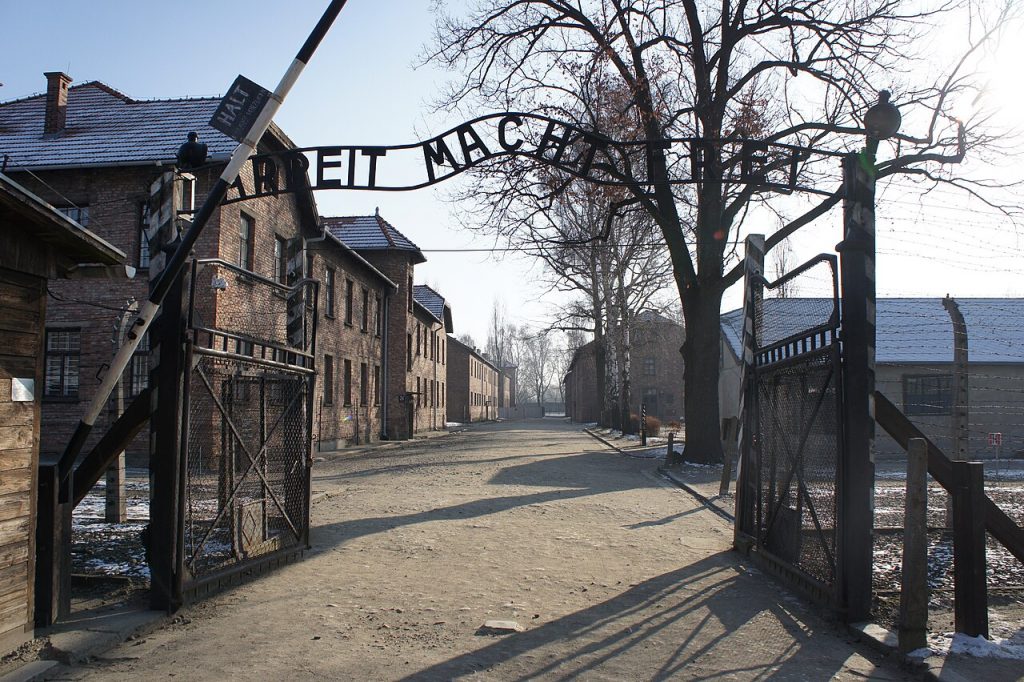
The 27th of January marks Holocaust Memorial Day, the anniversary of the liberation of the Auschwitz camp complex by Soviet Red Army troops. The day calls on us to remember the 6 million Jews murdered by Nazi Germany and its collaborators, alongside the many Roma, Sinti, gay, disabled, and political prisoners also murdered. Not only does this anniversary require us to remember the genocide of the 1940s, but to do all we can to fight against the genocides and crimes against humanity of the present – from Palestine to Sudan – and the still surviving threat of fascism, racism, and nationalism across the world.
Holocaust Memorial Day was established in 2000, when representatives from 46 governments met in Stockholm, going on to sign a declaration committed to preserving the memory of those killed in the Holocaust.
The liberation of Auschwitz is a significant date because it was the largest of all the camps. The Nazis established 1,000 camps by the end of the war (including satellite camps) with 40 concentration and extermination camps in Poland alone. Auschwitz itself was made up of 10 camps: the main camp Auschwitz I, the death camp Birkenau (Auschwitz II), the slave labour camp Monowitz (Auschwitz III), and seven sub-camps.
The Auschwitz complex saw the deaths of approximately 1,000,000 Jews, 70,000 Poles, 25,000 Sinti and Roma, and 15,000 prisoners of war. In the days before the Red Army arrived, most of the remaining prisoners (around 56,000) were forced onto a death march, with only 7,500 remaining in Auschwitz by the time it was liberated.
The Holocaust has been recognised as a particularly unique crime for its scale, and its systematic and industrialised nature. When we remember the Holocaust, history asks of us the solemn promise: never again. Therefore, to see Nazism as a unique evil of a century now past risks blinding us to the re-emergence of similar evils in other forms, under other names and labels.
It is important to remember the Holocaust was not a single moment but an escalating process over years: anti-Jewish riots (most infamously Kristallnacht), increased repression of communists and trade unionists, the taking of political prisoners, the forcing of Jewish people into overcrowded ghettos. Not to mention the centuries of antisemitism in Europe – not just Germany – before this. All this built up to the Nazi’s so-called ‘final solution’.
We must remember also the resistance throughout these years, such as the well-known Warsaw Ghetto uprising, alongside uprisings in the Auschwitz and Sobibor death camps. It is easy to make the mistake of portraying those killed in the Holocaust as agency-less victims, but it is as important to recall and be inspired by their resistance as it is to remember the horror and evils of that time.
Today, the world is faced by the horrors of genocide again. Israel’s unrelenting campaign to massacre and displace the Palestinian people continues – unchallenged and even aided by some of the same countries that once fought in the Allies. We have seen the shameful weaponisation of the term antisemitism to disparage those campaigning against genocide today. We also cannot ignore the spread of genuine antisemitic beliefs and conspiracies, especially online, wrongly using the crimes of Israel to justify renewed hatred against all Jewish people.
As communists, we and our allies in the workers and progressive movement must campaign against the falsification of history and misuse of past atrocities to justify modern ones. This also includes attempts to erase the role and significance of the Red Army in combating Nazism, to equate deaths under communist governments to the Holocaust, and to ignore the significance of anti-communism in Nazi ideology.
In Sudan, the ongoing civil war between the military and Rapid Support Forces has provided the context for massacres and the mass displacement of millions, with ICC Deputy Prosecutor Nazhat Shameem Khan reporting to the UN Security Council an organised campaign of “mass executions, rape and ethnic targeting, amounting to war crimes and crimes against humanity”. At least 150,000 have died since April 2023, and 12 million forced to flee. The RSF has been seen digging mass graves so large they can be seen from satellites.
The post-WW2 institutions that promised to prevent genocide and war around the world have been pushed to their limits. International laws and conventions against war crimes and genocide are flagrantly ignored, in front of the eyes of all the world. Here in Britain, a country that fought with the Allies against Nazism, our government enables a modern genocide in Gaza. Through the arms industry and RAF surveillance flights over Gaza, the British government has shown for all to see how little it respects the promise of never again.
When we remember the Holocaust we remember not only the horrors of 1940s Nazism, but of fascism, racism, and nationalism in all its forms, past and present. We are called on to remember what can happen if these movements and ideologies are not stopped in their tracks, and to commit ourselves to actively fighting against them every day of every year.
Racist and nationalist movements in Britain simultaneously draw on a patriotism that idealises Britain’s role in fighting Nazism, and scapegoat immigrants, religious minorities, the GRT community, and the very same communist and trade union movements the Nazis went after.
We must confront racist ‘explanations’ for our poor social and economic conditions head on, calling out their hypocrisy, while campaigning to eliminate these poor conditions in the first place, removing the fuel for racism and fascism’s fire. We must also confront imperialism, building the anti-monopoly alliance of workers and progressives, as it is the forces of imperialism that perpetuate and benefit from crimes against humanity and genocide around the world.
Proper education on antisemitism must be promoted and safeguarded, and the history of the Holocaust never rewritten or both-sided. The continued violation of people in the GRT community’s right to live and practice their culture with dignity must too be challenged and campaigned against.
81 years on from the liberation of Auschwitz, the fight against fascism and racism is still not complete. This Holocaust Memorial Day let us remember the 6 million Jews and others who were murdered. Let us be inspired by the uprisings against the Nazis and their collaborators, and other moments of resistance against fascism such as the Battle of Cable Street here in Britain.
Let our remembering of the Holocaust strengthen our determination to fight against the rewriting of history, against anti-semitism, against imperialism, and for the final victory over fascism and nationalism.
Let our generation fight to keep the promise our leaders have betrayed:
Never again.
Philip English, is the Editor of Challenge Magazine