This October marks the fourth Harry Pollitt School: the Marxist Leninist weekend school organised by the YCL. The school has become a key event in a young communist’s calendar, and a project which all comrades should be proud of, whether attending, organising, or speaking at.
Four years on from the event’s founding, at a time of a growing drive to war and significant efforts to renew Britain’s Marxist Leninist movement, it is as pertinent as ever to ask: why a Harry Pollitt School? Both why do we need the school itself, and why does it have that name?
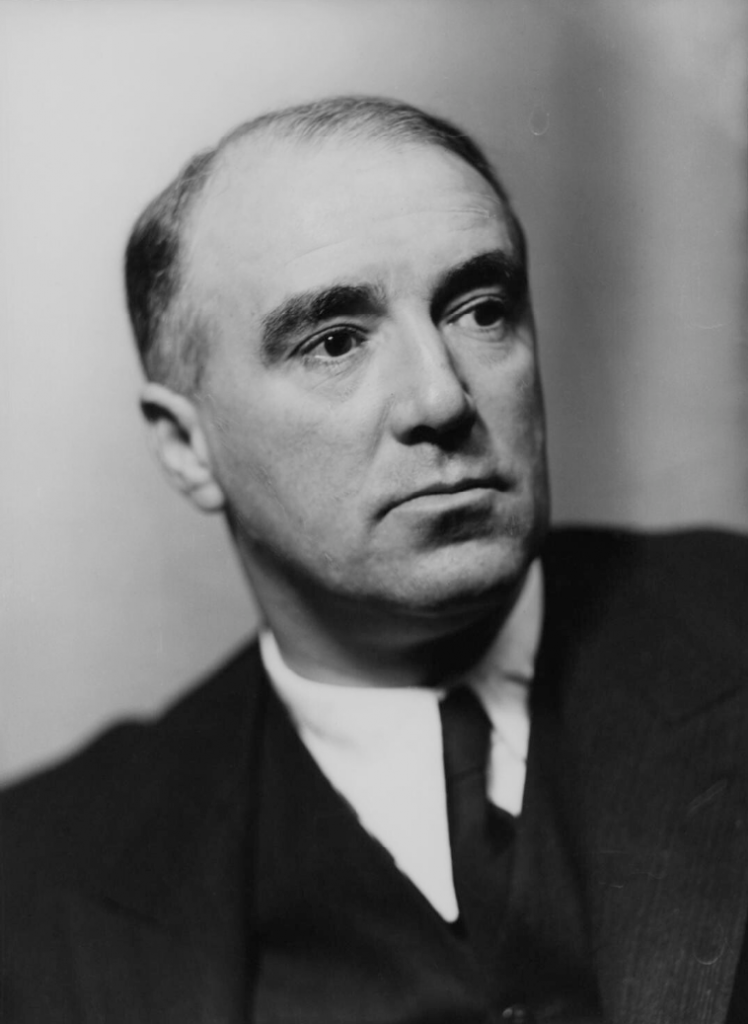
Who was Harry Pollitt?
Harry Pollitt was CPGB General Secretary for a good 25 years total, first from 1929 until 1939, and again from 1941 until 1956. The years of Pollitt’s leadership included the leftwards turn of Class Against Class; the fight against fascism in Spain, Britain, and the Second World War; and the adoption of Britain’s Road to Socialism – the programme that still guides the Communist Party and Young Communist League today.
So he was Party leader at significant points in its history. This is true, but could also be said of many Party figures. Rajani Palme Dutt was also General Secretary for part of World War 2, and a leading Party figure even when he was not. So was Willie Gallacher, never a General Secretary but one of the Party’s few Members of Parliament. Albert Inkpin was the first CPGB General Secretary, including in 1926, the year of the General Strike.
Then why honour Pollitt specifically? One key reason is that Pollitt’s life, and many of the positions he argued – sometimes in quite the minority of the Party leadership – raise questions that are still significant for us today.
Such questions include the role of communists in trade unions, our role in elections, relations with the Labour Party, war, and fascism.
The early years
Harry Pollitt was born in Droylsden in 1890, three decades before there was a CPGB. Three of his siblings died in infancy and as the eldest living, he and the eldest sister, Ella, had to grow up fast due to their mother returning to the mill where she had worked. Harry himself started working when he was still a child, at the same factory as his mother from age 12.
The injustice Pollitt saw from a young age, especially the lot of his mother, drove him. He said of her:
“Every time she put her shawl round me before going to the mill on wet or very cold mornings, I swore that when I grew up I would pay the bosses out for the hardships she suffered.”
His mother also helped begin his political education, taking him along to meetings, with Pollitt following her in joining the local Socialist Sunday School. She proposed him as a member of the Openshaw Branch of the Independent Labour Party in 1906, when he was still in his teens.
The ILP was one of multiple organisations that affiliated to the Labour Party. Labour, especially in its founding, was unlike traditional political parties in that you didn’t join as an individual member, but through affiliated organisations such as the ILP or many of the trade unions. This is why, for a time, Communist Party members could also be in Labour.
Pollitt was an active member of the Openshaw Socialist Society – which was established by the ILP in 1906, but seceded from the ILP and local trades council, becoming in 1912 a branch of the new British Socialist Party (a forerunner of the CPGB).
Critical of Labour, the Openshaw branch would run against official Labour candidates in multiple municipal elections, despite this being against official BSP policy. Pollitt supported this approach and wrote his first leaflet Socialism or Social Reform? in 1911 for the first of these elections.
Pollitt and the Openshaw branch were anti-war from start. Pollitt was due to speak at Ashton Market, near military barracks, on what became the first Sunday of WW1, and still did so even with the breakout of war. He called out the warmongering, which unfortunately enraged the crowd and, in quite the dramatic turn of events, left him being escorted by two policemen to get safely back to the tram.
We could learn a lot from Pollitt’s bravery and passion in the struggle against war today, even if we may want to pick our speaking venues more carefully.
Hands off Russia!
Pollitt was a staunch promoter from the start of the Hands Off Russia! movement. The campaign began with a conference, including representatives of the British Socialist Party and Socialist Labour Party, and would go on to form a committee of representatives from a number of trade unions.
One instance of successful worker solidarity with Russia came on May 10th 1920, shortly after Poland attacked Soviet territory, when London dockers refused to coal the S. S. Jolly George, that was set to take munitions to Poland.
The culmination of the Hands Off Russia! campaign was that August, when a Council of Action representing the Labour Party, TUC, and 350 local Councils of Action, threatened a General Strike should the government enter the war.
The lessons of Pollitt and others’ involvement in this campaign can teach us a lot about the importance of international solidarity campaigns today, for example the Cuba Solidarity Campaign, or our work against a New Cold War on China.
Organising the Party
After the CPGB was founded, one of Pollitt’s first roles would be on a 3-person commission, dedicated to restructuring the Party to be more in line with the approach of the Communist International. Pollitt would be joined in this role by Rajani Palme Dutt and Harry Inkpin. All three were brought in from outside the Party leadership of the time.
This restructuring introduced elements we still recognise in the Party and YCL today: the vertical flow of regular reports from branches up to higher bodies and of instructions back down, and the turning of branches from occasional talking shops into tight working groups.
Pollitt would play a major role in organising the network and distribution of the Worker’s Weekly, set up by Dutt in 1923, quickly becoming a far more successful publication than its predecessor the Communist.
Pollitt devoted much of his energy towards industrial work, and shortly after the 6th Congress of the Party was elected as secretary of the new National Minority Movement. The NMM was promoted by the Party as a broader movement of the militant minority within the unions – so including the Communists but also militants outside of the Party.
The NMM sought to overcome sectional divisions in the movement, learning the lessons of Black Friday (April 15th, 1921) when the miners were abandoned by the wider movement to fight alone.
The NMM was at its peak in 1926 – the year of the general strike – when 500 organisations across a range of industries sent representatives to its annual conference.
Looking at the National Minority Movement can inform our approach to unity today. The Party/League strategy is that of building a united front against monopoly capitalism and war. The aim is to unite a militant labour movement at the core of this front, around a shared left wing program, incorporating other allies in the fight against imperialism.
Pollitt was one of a number of communists arrested in the months before the General Strike, and one of three to deliver a political defence against the charges. He was sentenced to 12 months imprisonment, spending the General Strike locked up in Wandsworth Prison.
The Third Period and Class Against Class
Pollitt would become leader of the Party in 1929. This was the beginning of the Class Against Class period, typically understood as a turn towards ultra-left sectarianism, as part of a wider leftward shift taking place across the international communist movement, known as the Third Period.
It was in this period that the Party made its break with Labour, dropping its efforts to affiliate (the Communists having been banned from dual membership by Labour in 1925). Pollitt had long been sceptical of the Labour Party and the role of parliament – as we saw in his days in the Openshaw BSP – so it is unsurprising that this was the period he rose to Party leader.
This isn’t to say the Party abandoned elections in this period, quite the opposite, they took to standing against an even wider array of Labour candidates than previous. Pollitt himself stood against Labour leader Ramsay MacDonald in the May 1929 election.
Where Pollitt did differ with the international line of the Third Period was on industrial policy.
Pollitt was less favourable to an outright break with the unions and the potential of working without and against their apparatus, establishing our own red unions, but instead winning the masses over to Communist leadership while remaining within and as an integral part of the unions.
Additionally, Pollitt was, after all, a leading figure in building up the National Minority Movement within the unions (still NMM secretary at the time) and had little reason to abandon the ground they had gained.
It would be overly simplistic to write this period off as purely blind sectarianism – communists including Pollitt had been arrested before and during the General Strike, they had been forced out of the Labour Party before the Class Against Class period. The new line was perhaps an understandable response to already being isolated and separated from the wider movement, but it came with its own challenges and mistakes.
Communists today have a lot to learn from examining the Class Against Class period: discussing topics like ultra-leftism, our election strategy, and the role of Communists within trade unions.
This period would only last a few years, however, as the Party, and the world, approached the Second World War.
Anti-fascism
By the mid-1930s, the Party was well engaged in the struggle against fascism. Key in this shift was an emphasis on looking for allies beyond the Party and labour movement, while also remaining embedded and active in said movement, and uniting against the National Government – for whom much of Pollitt’s criticisms were actually focused, the fascist Blackshirts a symptom of the Government’s failure rather than the sole enemy.
Such a shift was not alone in Britain, as the international communist movement would shift towards the Popular Front strategy – broader than the United Front in size and class character – to bring together all anti-fascist forces.
One of the most difficult periods for Pollitt’s leadership came with the outbreak of World War 2. He was at odds with the International’s anti-war position, instead supporting war on Germany, which Pollitt explained was in large part motivated by what he had seen in the anti-fascist struggle in Spain, and the sacrifice of the International Brigades (of whom the Irish and British volunteers were mostly members of the Communist Party and YCL – around 80% of volunteers).
It was on this disagreement between Pollitt and much of the Party that would lead to his brief demotion from CPGB General Secretary. From October 1939, until June 1941, the role would be taken by another major figure of Communism in Britain, Rajani Palme Dutt.
The International would, of course, go on to recognise the anti-fascist character of the Second World War, so perhaps Comrade Pollitt can be forgiven for being too eager too early.
Conclusion
So, to end where we started, why a Harry Pollitt School?
Firstly, because of the personal story of Harry Pollitt. His unwavering passion, his lifelong quest for justice, his rise from child labourer to perhaps the most well-known General Secretary of the CPGB. This makes Harry Pollitt, as a person, a great inspiration to us all.
Secondly, because of his politics, and the debates that surrounded his time in leadership of the Party. These debates covered almost every realm of the struggle: how to organise the Party; how we relate to parliament, Labour, and the unions; ultra-leftism, anti-fascism, and the struggle against war.
Finally, because Britain’s youth need a Harry Pollitt School. We face a drive to war, and the resulting failure to provide good jobs and futures for our generation, that only a Marxist Leninist Communist Party can overcome. To be entrusted with educating the next generation of that Party, as the YCL has, is the honour and the challenge of a lifetime.
This year’s Harry Pollitt School will run across the weekend of October 10th and 11th, at the Irish World Heritage Centre in Manchester
Tickets can be bought here.
Philip English, is the Editor of Challenge Magazine, and will be speaking at a session on journalism at the School.
While not a Marxist Leninist text, Kevin Morgan’s Harry Pollitt provided a useful summary of key dates and events in Pollitt’s life. The quote by Pollitt on his mother’s lot was sourced from said text.