
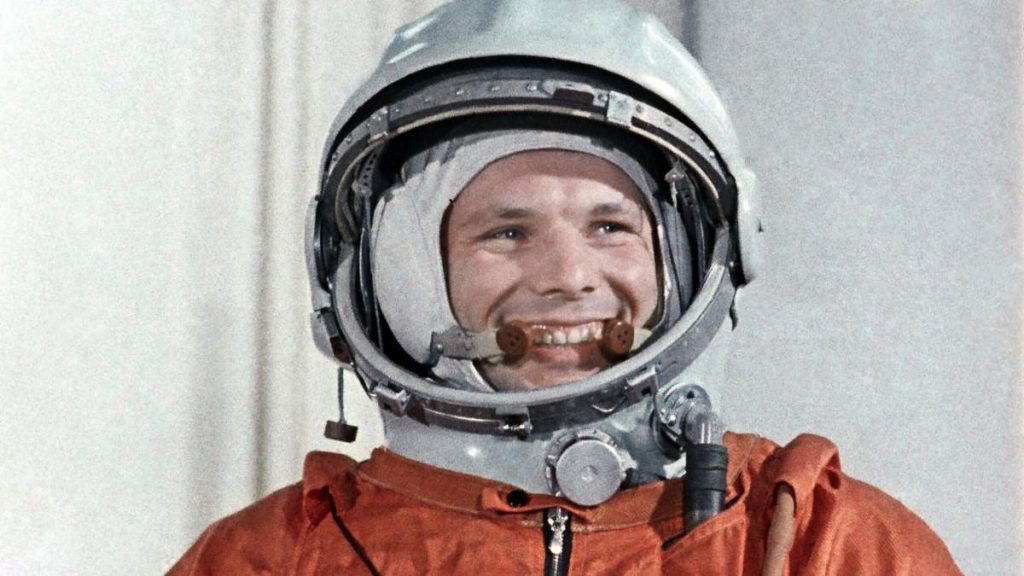
On the 12th of April 1961, at 11:07am local time, the quiet landscape of the Aral Karakum desert was interrupted by a monumentous roaring of engines. Far above the sands and shrubbery, a flickering point of light, trailed by a growing plume of clouds, could be seen for miles around as it ascended into the heavens. This light was the fire that took the Vostok-1 spacecraft into orbit around the Earth. Within it sat a single passenger: Yuri Gagarin – the first of us to see our world from above.
As the final stage of the rocket activated and Gagarin reached orbit, he declared: “Kosberg has worked!” (Semyon Kosberg being the rocket engine’s chief designer.) With this simple statement, Gagarin made the recognition that, even though he was alone in his spacecraft, the historical achievement of sending a man to space was not solely his. Behind him were countless thousands of engineers, scientists, manufacturers, and indeed the whole socialist system itself.
Gagarin was born in 1934 to a family of collective farmers in west Russia. When he was just 7 years old, Nazi invaders occupied his village. They burned down his school, stole his home, and placed his family into forced labour to feed the occupying troops. Despite his young age, Gagarin responded to these terrible acts with strength and courage, choosing to covertly sabotage the Nazi war effort by pouring soil into tank batteries.
Once the war ended, Yuri went back to school, where he attained a great passion for maths, the sciences, and engineering. As he grew older, he gained experience in practical fields like steelmaking and the design of tractors, all the while being given the opportunity to develop his lifelong interest in aeroplanes. It was this interest that led him to join the Soviet Air Force and which – after four years of service – gave him the opportunity to be selected for the Vostok program.
At any prior point in history, Yuri Gagarin would have lived the life of an uneducated peasant – never being given the opportunities to develop his passion and expertise. But he did not live at any prior time, he lived under socialism: a system which raises the masses to the level of masters, a system which gives them the reigns of history, a system which – even at a young age – Gagarin risked his life to protect. It was socialism that allowed an ordinary person to do something extraordinary.
Compare this to the private space programs of the capitalist class today. What are their ambitions? Tourism for the wealthy, satellite networks that ruin astronomical data, promises of asteroid mineral extraction and colonies on other worlds. In short: exclusivity, recklessness, exploitation, and colonialism. To the capitalist, space is nothing but another resource to extract and another frontier to conquer, fresh blood to prolong its vampiric existence.
This is not the socialist view. Gagarin’s space flight, a historic achievement of the socialist system, was not a feat of conquest, but one of scientific discovery. The first journey of our species beyond our home planet was an immense responsibility, and a service to all who will follow in Gagarin’s footsteps. We celebrate the anniversary of this feat, and recognise that within this service lay a promise: when we travel into the Cosmos, we will greet it as equals.
“I would like to dedicate this first space flight to the people of communism, a society which our Soviet people are already entering, and which, I am confident, all men on Earth will enter.”
Yuri Gagarin
Rose Raistrick, is a member of the YCL’s Greater Manchester Branch
Featured Image: Cosmonaut Yuri Gagarin, by ТАСС, licensed under CC BY 4.0