For What Died the Sons of Róisín, was it fame?
For what flowed Ireland’s blood in rivers?
And did not cease nor has not ceased
With the brave sons of ’16
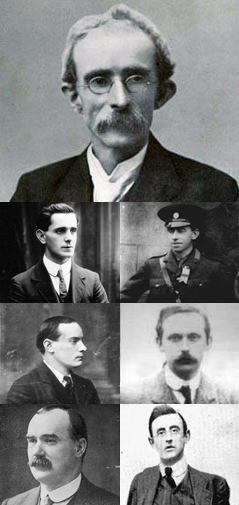
110 years ago this week, men and women from the Irish Citizen Army (An explicitly working class organisation), the Irish Volunteers (A broader armed Independence formation) and Cumann na mBan (A revolutionary women’s organisation) took up positions across Dublin under the banner of the Irish Republic – having been proclaimed for and by ’ Irishmen and Irishwomen: In the name of […] the dead generations from which she receives her old tradition […] summons her children to her flag and strikes for her freedom.’ 2 Seven names signed this document encompassing the broad array of progressive forces in Ireland at the time: Pádraig Pearse the Irish language poet and leader if the Irish Volunteers, Tom Clarke the protestant son of a British Army sergeant and high council member for the Irish Republican Brotherhood and James Connolly, the hardened socialist and commandant of the armed workers in the Irish Citizen Army.21
Strike these brave children did, through force of arms holding out for five days against a British occupation at the height of imperial hubris and associated cruelty. A tumultuous week ensued, but some moments in particular are worth highlighting: The delay of over 1,700 British reinforcements by a handful of Republican fighters for 9 hours at Mount Street Bridge, the indiscriminate shelling of central Dublin by British artillery and the Gun Boat Helga and the holding of the rebel headquarters of the General Post Office on O’Connell Street until they were burned out, as the seriously wounded James Connolly refused to be evacuated from under the fluttering green banner inscribed in gold ‘Poblacht na hÉireann’.4
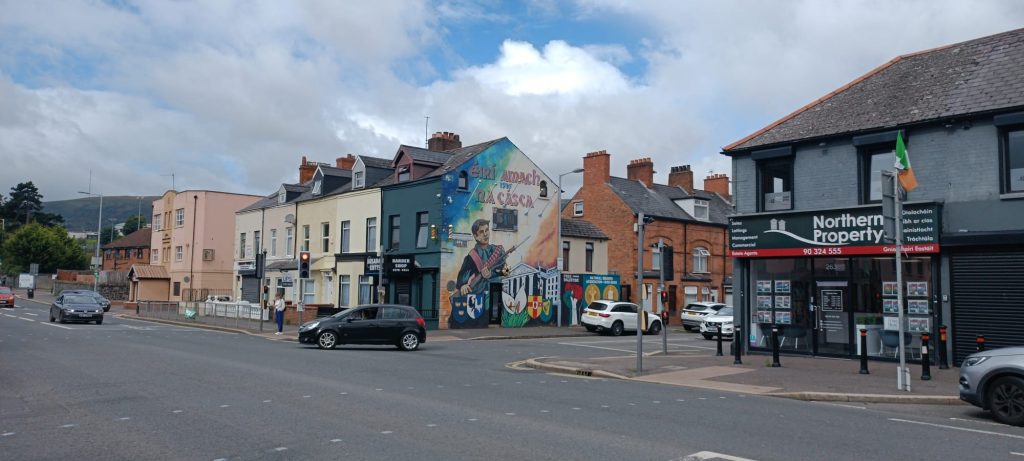
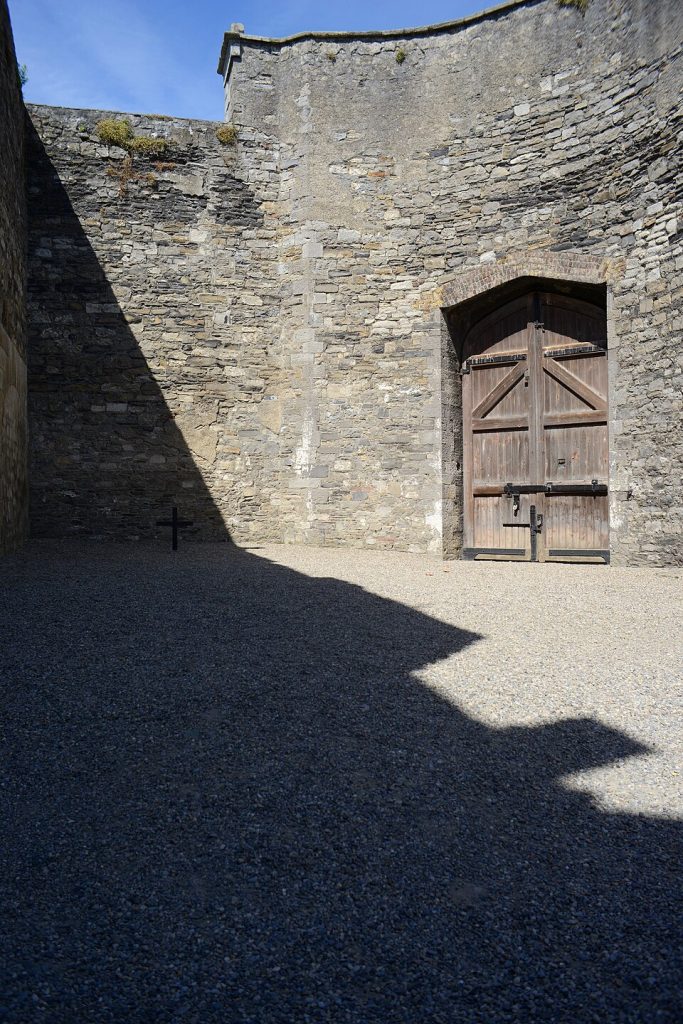
Ultimately however, the rising failed in it’s immediate goal of the establishment of an Irish Republic. In the words of Lenin ‘It is the misfortune of the Irish that they rose prematurely, before the European revolt of the proletariat had had time to mature’, as less than a year later Revolution that erupted in Petrograd would soon set all of Europe alight – indeed it’s not a stretch to say Easter 1916 was the spark that lit the prairie fire. All of it’s leaders were executed one by one in Mountjoy Gaol under the accusation of treason. Most egregiously was the case of James Connolly – who had to be tied to a chair so that the execution by firing squad could be carried out. According to his daughter Nora, a Welsh solider that carried out this act found her and her family in the immediate aftermath and begged for forgiveness, saying he as a man ‘who was a member of the labour movement all his life’ could not go on living without it. The context the rising found itself in were varied, complex and overlapping. The most obvious was that of the great imperialist clash of the first world war and the conscription crisis brewing in Ireland. In the Irish context this produced a crisis not dissimilar to those faced by progressives across Europe.16 24
“ T’was England bade our wild geese go, that small nations might be free “
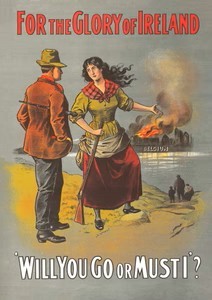
Groups such as the Irish Parliamentary Party and sections of the Irish Volunteer leadership encouraged recruitment to the British army so as to strengthen the demand for ‘Home Rule’ that had caused crisis in Westminster prior to the outbreak of the war. Many motivated either by belief in this process or the dire poverty across Ireland heeded this, British propaganda even appealed to this with posters depicting Belgium under German occupation hoping to draw sympathy from Irish men who saw similarity between both small nations occupied by a larger neighbour – A cruel inverse of the renowned Irish legions who fought for revolutionary France a century prior. Opposed to this were sections of the Irish volunteers, led by several of the later signatories of the Proclamation of the Republic. The organisation no doubt lost weight in numbers, but it was the conviction of those leaders that what remained was an army of higher quality and of a steadfast conviction in the need for an Irish Republic, brought about by force if necessary. The other component of the rising, the Irish Citizen Army, was hardened by the intense episode of class struggle that rocked Dublin a few short years earlier.
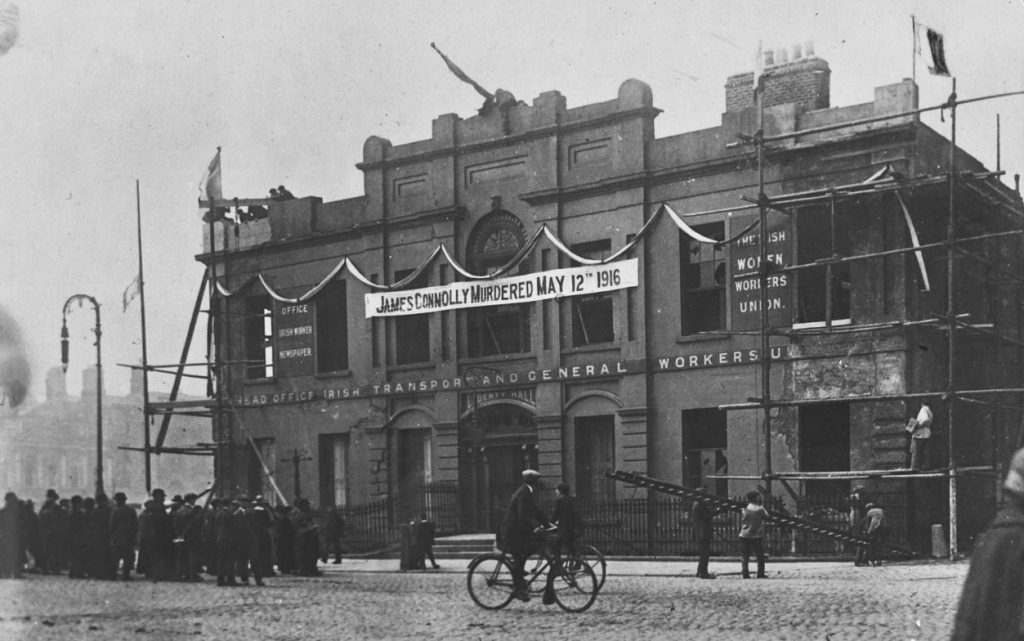
The bitter memory of the 1913 Dublin Lockout still loomed large in the memories of many of the rebels. Under the leadership of James Connolly, Constance Markievicz (the first woman elected to Westminster who famously advised all Irish women to ‘leave your jewels in the bank, and buy a revolver’) and James Larkin, over 20,000 workers in Dublin engaged in ‘Industrial War’. For over 17 months employers, first large then small, locked workers out of their workplaces unless they signed a pledge that prohibit them from any sort of trade union organising. Over the course of events all aspects of industrial war were experienced: the jailing of leaders, the appeals for another ‘sympathetic strike’ front in Britain that often fell on deaf TUC ears, and the violence enacted on the strikers by scabs and blacklegs alike. The latter of these showed the immediate need to not only prepare but arm the workers. A need known wholeheartedly by the workers who, upon hearing Connolly proclaim that for every man wishing to join the labour army, ‘’he had competent officers ready to instruct and lead them, and could get them arms anytime they wanted them.” The announcement was greeted with deafening cheers’. 31
Cathal Ó Gaillín, is a member of the YCL’s Lanarkshire Branch and International Department
This article is the first in a 3-part series. Find part 2 here.
[1]
[2]
‘30 women, five years: the cost of silence in the face of male violence’, Impartial Reporter. Available: https://www.impartialreporter.com/news/25959295.bernadette-mcaliskey—30-women-five-years-cost-silence/
[3]
‘CAIN: Proclamation of the Irish Republic, 24 April 1916’. . Available: https://cain.ulster.ac.uk/issues/politics/docs/pir24416.htm
[4]
‘Chronology of the Easter Rising | Century Ireland’. Available: https://www.rte.ie/centuryireland/articles/chronology-of-the-easter-rising
[5]
‘Constitution of the United Irishmen, 1797 – Cartlann’. Available: https://cartlann.org/authors/united-irishmen/constitution-of-the-united-irishmen-1797/
[6]
‘Coventry family wins legal battle for Irish wording on gravestone | Religion | The Guardian’. . Available: https://www.theguardian.com/world/2021/feb/25/coventry-family-overturns-ban-on-gaelic-wording-on-gravestone
[7]
‘Economic Manuscripts: Capital Vol. I – Chapter Twenty-Five’. . Available: https://www.marxists.org/archive/marx/works/1867-c1/ch25.htm#S5f
[8]
‘Food Exports from Ireland 1846-47 – History Ireland’. Available: https://historyireland.com/food-exports-from-ireland-1846-47/
[9]
J. Glass and P. A. L. Editor, ‘“I’m a free mawn”: Kneecap’s Mo Chara celebrates as UK government loses appeal over rapper’s terror charge’, The Irish News. Available: https://www.irishnews.com/news/northern-ireland/kneecap-rapper-mo-chara-wont-face-new-terror-trial-after-cps-lose-appeal-MTU5FCJX4FFNNNOWVN6WGQN7YE/
[10]
By, ‘Ireland’s Red Troubadour’.. . Available: https://tribunemag.co.uk/2019/01/irelands-red-troubadour
[11]
‘Irish Immigration Impact on Scotland | PDF | Scotland | Scottish People’. . . Available: https://www.scribd.com/doc/152217519/Menace-of-the-Irish-Race-to-our-Scottish-Nationality
[12]
‘James Connolly – James Connolly Society’. . . Available: https://jamesconnollysociety.com/james-connolly/
[13]
‘James Connolly: The Re-Conquest of Ireland (1915)’. . . Available: https://www.marxists.org/archive/connolly/1915/rcoi/index.htm
[14]
‘Key Events and Timeline of 1798 Rebellion’. . Available: https://1798centre.ie/history/timeline-of-1798/
[15]
‘Learn | Ireland’s Great Hunger Museum’. . . Available: https://www.ighm.org/learn.html
[16]
‘Lenin: The Discussion On Self-Determination Summed Up’. Accessed: Apr. 02, 2026. . Available: https://www.marxists.org/archive/lenin/works/1916/jul/x01.htm
[17]
‘Letters: Marx-Engels Correspondence 1869’. . . Available: https://www.marxists.org/archive/marx/works/1869/letters/69_11_29-abs.htm
[18]
‘Letters: Marx-Engels Correspondence 1869’. . . Available: https://www.marxists.org/archive/marx/works/1869/letters/69_12_10-abs.htm
[19]
M. Staines, ‘“Most of my friends are emigrating” – Young people priced out of tourist hotspots’, Newstalk. . . Available: https://www.newstalk.com/news/most-of-my-friends-are-emigrating-young-people-priced-out-of-tourist-hotspots-1482576
[20]
The Late Late Show, ‘My Generation…’ Blindboy Boatclub – The Rubberbandits | The Late Late Show | RTÉ One, (Jan. 09, 2016). . [Online Video]. Available: https://www.youtube.com/watch?v=2v1kuaWCj1U
[21]
‘National Library of Ireland – 1916 Exhibition’. Accessed: Apr. 02, 2026. . Available: https://www.nli.ie/1916/exhibition/en/content/sevensignatories/
[22]
‘Neglect in the North of Ireland’, Ebb Books. . . Available: https://www.ebb-books.com/books/p/neglect-in-the-north-of-ireland
[23]
K. Mellett, ‘“No Irish, No Blacks, No Dogs”: Irish Times readers recall seeing notorious signs in Britain’, The Irish Times. . . Available: https://www.irishtimes.com/ireland/social-affairs/2024/05/06/no-irish-no-blacks-no-dogs-irish-times-readers-recall-encountering-notorious-signs-in-britain/
[24]
Walter Lawler Archive – Regular Video Uploads, Nora Connolly O’Brien Interview 1965, RTE, (Nov. 03, 2025). Accessed: Apr. 02, 2026. [Online Video]. Available: https://www.youtube.com/watch?v=ann0OF0Br38
[25]
‘On the Irish Question by Karl Marx’. . . Available: https://www.marxists.org/archive/marx/works/1867/12/16.htm
[26]
‘On this day in history… a forgotten Irish Famine started. | Radboud University’. . . Available: https://www.ru.nl/en/research/research-news/on-this-day-in-history-a-forgotten-irish-famine-started
[27]
‘Orange Lodge makes fresh bid for Stonehaven parade’, BBC News. . . Available: https://www.bbc.co.uk/news/articles/c5y9dv70znzo
[28]
‘Political Resolution of the 26th National Congress’, Communist Party of Ireland. . . Available: https://communistparty.ie/en/policies-documents/political-resolution-of-the-26th-national-congress/
[29]
‘The Agricultural Proletariat’. . . Available: https://www.marxists.org/archive/marx/works/1845/condition-working-class/ch12.htm#ireland
[30]
G. O’Brien, The economic history of Ireland from the union to the famine. London, New York [etc.] Longmans, Green and co., 1921. . . Available: http://archive.org/details/economichistoryo00obri_2
[31]
C. D. Greaves, The life and times of James Connolly. Croydon: Manifesto Press, 2018.
[32]
‘The National 1798 Rebellion Centre – Plan Your Visit’. Accessed: Apr. 02, 2026. . Available: https://1798centre.ie/
[33]
C. Ó Grada, ‘The population of Ireland 1700-1900 : a survey’, Annales de Démographie Historique, vol. 1979, no. 1, pp. 281–299, 1979, doi: 10.3406/adh.1979.1425.
[34]
E. McCartan, ‘The Struggle to Maintain and Build Our Neutrality Heats Up’, Socialist Voice. . . Available: https://socialistvoice.ie/2026/03/the-struggle-to-maintain-and-build-our-neutrality-heats-up/
[35]
P. B. R.- poweredbyreason.co.uk, ‘The tale of the Manchester Martyrs’, People’s History Museum. . . Available: https://phm.org.uk/blogposts/the-tale-of-the-manchester-martyrs/
[36]
‘The world can criticise Kneecap, but they have started something’, May 2025, . . Available: https://www.rte.ie/culture/2025/0503/1510512-the-world-can-criticise-kneecap-but-they-have-started-something/
[37]
‘Weapons of war went through Ireland’, The Ditch. Available: https://www.ontheditch.com/weapons-of-war-checked-shannon-airport/
[38]
‘YCL International Department Condemns Not Guilty Verdict of “Soldier F”’, Young Communist League of Britain. . . Available: https://ycl.org.uk/2025/11/01/ycl-international-department-soldier-f/
[39]
‘Young People Considering Emigrating for Better Life’, National Youth Council of Ireland. . . Available: https://www.youth.ie/articles/young-people-considering-emigration-for-better-quality-of-life-than-in-ireland/
[40]
Liberty Hall bombarded house Beresford Place May 17 [1916] – Digital Repository of Ireland. doi: https://doi.org/10.7486/DRI.3b591882v.