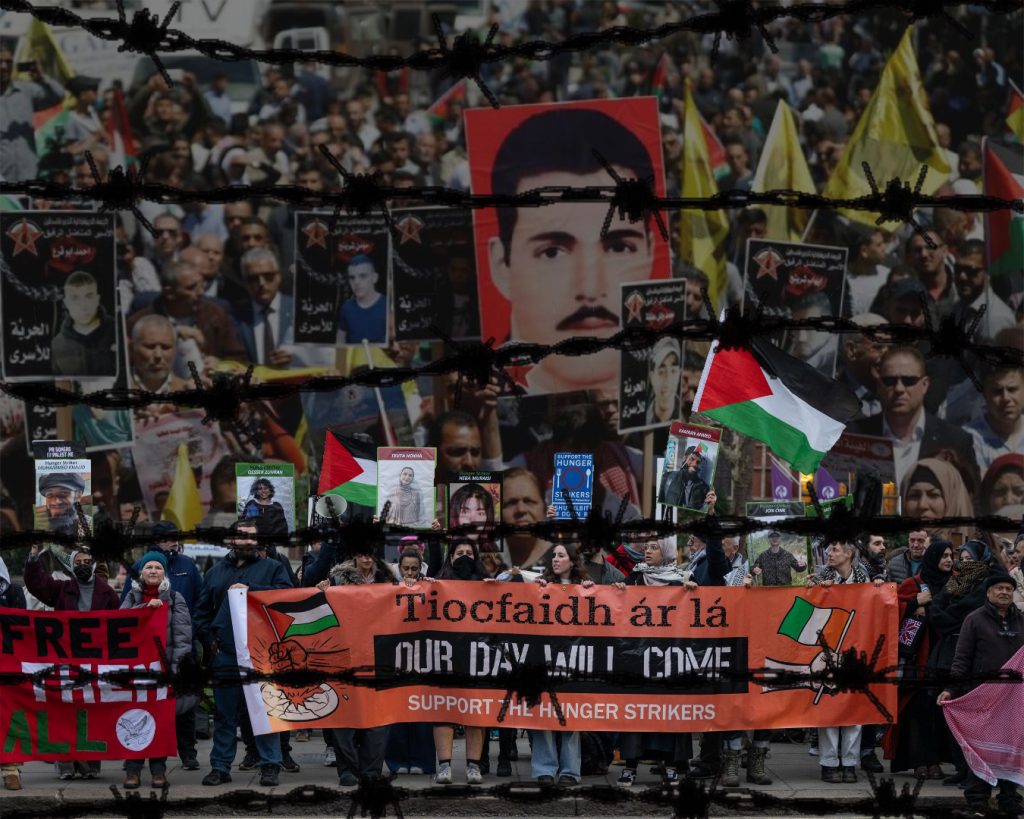
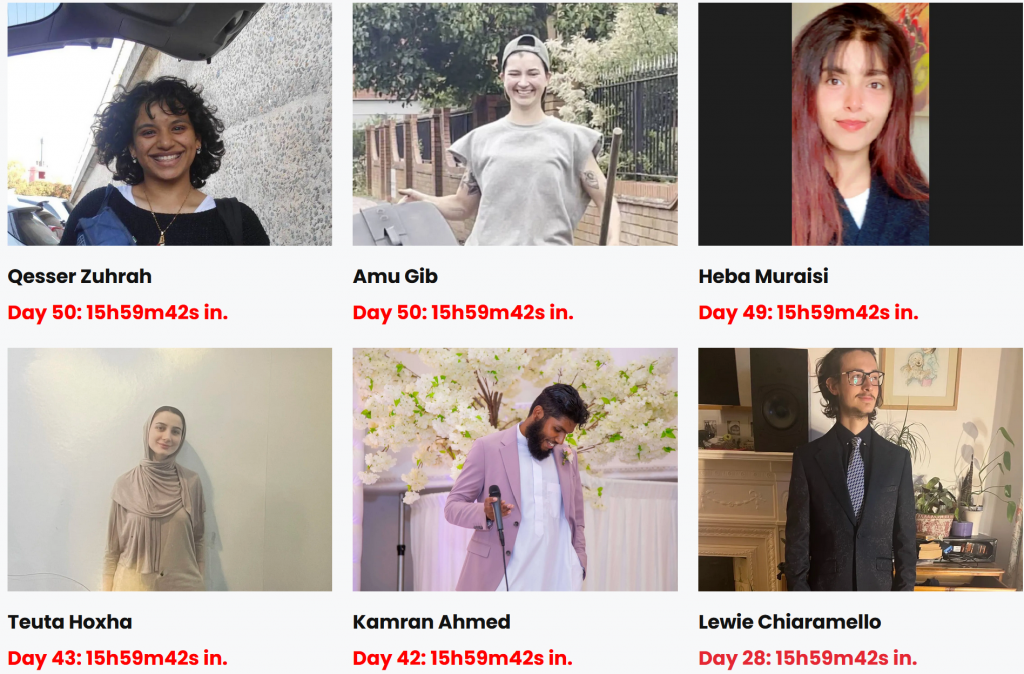
As I write this Qesser Zuhrah, aged just 20, stands on the threshold of another world. She has been rushed to hospital only following protests outside the gate of HMP Bronzefield, requiring urgent medical attention as her hunger strike enters it’s 47th day and the ‘critical stage’. She, along with five other prisoners aged between 20 and 31, are engaged in the highest form of detained struggle, that of the hunger strike, using their last piece of leverage against the British state that has detained them – their very lives.
These six make up part of the thirty three detained by the British State for actions aimed to materially hinder Israel’s ongoing Genocide in Palestine – most notably targeting RAF Brize Norton and various sites of drone manufacturer Elbit Systems. The involvement of RAF assets based in Akrotiri to surveil Gaza at the behest of Israel and the murderous use of Israeli drones across Palestine and Lebanon is well documented and beyond the scope of this article. Actions taken to inhibit this wholly align with international law, and most importantly have been effective. For this reason, the British state has seen it necessary to proscribe organisation Palestine Action as a terrorist organisation – placing it in the same bracket as groups such as Daesh and the Neo-Nazi National Action. To try and claim a group that engages in property damage is on the same plane as those that openly declare their intention to murder on the basis or ethnicity or religion is blatantly a political move.
This has been decried as a ‘disturbing misuse of UK counter-terrorism legislation’ and ‘hindering the legitimate exercise of fundamental freedoms’ by UN organisations. This has led to over 1,600 people across Britain being arrested and charged under Anti-Terror powers for wearing t-shirts, holding slogans and other trivial expressions. Not content with this, the state has increased the repression on those it holds – denying bail for charges such as aggravated burglary, retrospectively applying terrorist charges for alleged acts taken before proscription and delaying trial dates until 2026 or even 2027, to name just a few. This is quite simply imprisonment without trial – a trial the state knows it may lose, and so for political reasons can neither try nor release them. In light of this, the prisoners have listed 5 simple, and very achievable demands – including bail, de-proscription and to shut Elbit down. These have been continually ignored by the British State, spearheaded by David Lammy, leading these prisoners to embark on the path they have chosen.
This path chosen by both anti-imperialist jailed and imperialist jailer is nothing new for British prisons. In 1971, Westminster directed a campaign of internment across occupied sections of my country, kidnapping and then jailing over 300 Irish men and women across the North of Ireland – without trial, presentation of evidence and often times merely for being known as being politically active against the discriminatory practices of Stormont and Westminster. Over the next 4 years, over 1,900 were interned, 95% Irish, and held in makeshift camps such as Long Kesh.
Their ‘special category’ or political prisoner status then began to be phased out in 1976, leading to escalating ‘blanket’ or dirty protests across the Maze and Armagh women’s prison, a struggle that ultimately culminated in 1981’s Hunger Strikes in the H-Blocks of the Maze prison, formerly Long Kesh. Hunger strikes have a long history and special place in both Irish culture and the physical force Republican movement. This history was revived in 1976 when Frank Stagg died on hunger strike in a Yorkshire prison after authorities refused to transfer him to a local jail. Knowing this and faced with no other options to achieve their rightful demands, the 1981 hunger strikes began on March 1st, the 5th anniversary of the announced end of ‘special category status’. It saw 10 prisoners across the Irish National Liberation Army and Irish Republican army, led by Bobby Sands, begin to refuse food on a rolling basis. Their demands included such simple and achievable points such as the right to one letter and parcel per week, and to organise educational facilities. From that March until October, 10 men from died as Martyrs for Irish freedom – including both Kieren Doherty who was elected to the Dáil (Irish parliament), and Bobby Sands elected to Westminster. These martyrs included accomplished sportsmen such as All-Ireland winner Kevin Lynch, ordinary decorators such as Francis Hughes and farmers like Martin Hurson. They represented the most militant, most courageous sections of Ireland’s youth – thrust by occupation into captivity and sacrifice – these 10 aged from 23 to 30 gave their youth and lives to stand against to British imperialism.
The shame of Thatcher being the first Prime Minister to have another MP murdered was felt not just in occupied Ireland but worldwide, from Moscow Pravda decried ‘another tragic page in the grim chronicle of oppression, discrimination, terror and in violence’ of Britain in Ireland, in Ghent the British Consulate was occupied and from France to Tehran streets were named in Sands’ honour. These events have left a deep mark on the revolutionary Irish psyche, from famous songs such as the Ballad of Joe McDonnell, world renowned murals and annual commemorations that attract thousands. In light of this sacrifice, worldwide outpouring of support and galvanisation of the struggle in Ireland, the British government was forced to make concessions – meeting most of the key demands almost immediately once the strike was called off. The sacrifice of the martyrs on the inside, and the actions of the solidarity movement on the outside had produced victory. I’m keenly aware as an Irish man born in occupied Ireland that I owe my right to a passport dawned with the harp, the right to speak my own language and Irish unity, when it comes, in no small part to these people.
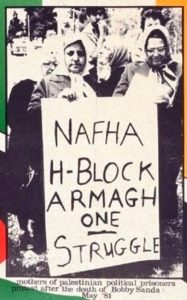
The international support was felt most poignantly however in another occupied land – that of Palestine. Upon hearing the news of Sands martyrdom, a letter was smuggled out of Israel’s Nafha prison by Palestinian prisoners reading ‘We salute the heroic struggle of Bobby Sands and his comrades, for they have sacrificed the most valuable possession of any human being. They gave their lives for freedom.’ The Palestinian prisoner struggle has deep roots, where they faced internment by another name, administrative detention, during the British suppression of the 1936 revolt. This has carried through to 1968, the intifadas and today. Similarly present in murals, slogans and other cultural expressions. The song Ya Taleen, repopularised recently by Dana Saleh, was sung by women marching up hills to visit their British held relatives. It’s coded messages echoed among the landscape so the prisoners could hear clearly that they were not alone – ‘to those gazelles who are jailed inside, I want to tell you that this situation will not last’.
The hunger strike has been similarly employed by Palestinian prisoners, through the ‘battle of empty stomachs’ they have demanded basic rights such as family visits and access to phone calls. For this I draw attention to 2017, where on prisoner’s day of 17th April over 1,500 prisoners embarked on this battle, this included still jailed Marwan Barghouti, Ahmed Sa’dat and members of all currents – Islamic, Nationalist and Communist. Among their demands was the end to the aforementioned policy of administrative detention. Of the over 10,000 Palestinians held captive by Israel many have been jailed due to this British originating policy. My dear friend Alaa Srouji is among these numbers, director of the Al-Awda community centre in Tulkarem, brutally beaten and kidnapped from his family home and now held in brutal conditions in Ofer prison. In Ofer, as in all Israeli prisons, the kidnapped are subject to inhumane living conditions, medical neglect, inadequate food and torture. Since October 2023 at least 98 Palestinian prisoners have been murdered in the Israeli prison system. This number is likely far higher, as bodies are frequently returned to Gaza unidentifiable but showing clear signs of torture, still bound and with evidence of summary execution.
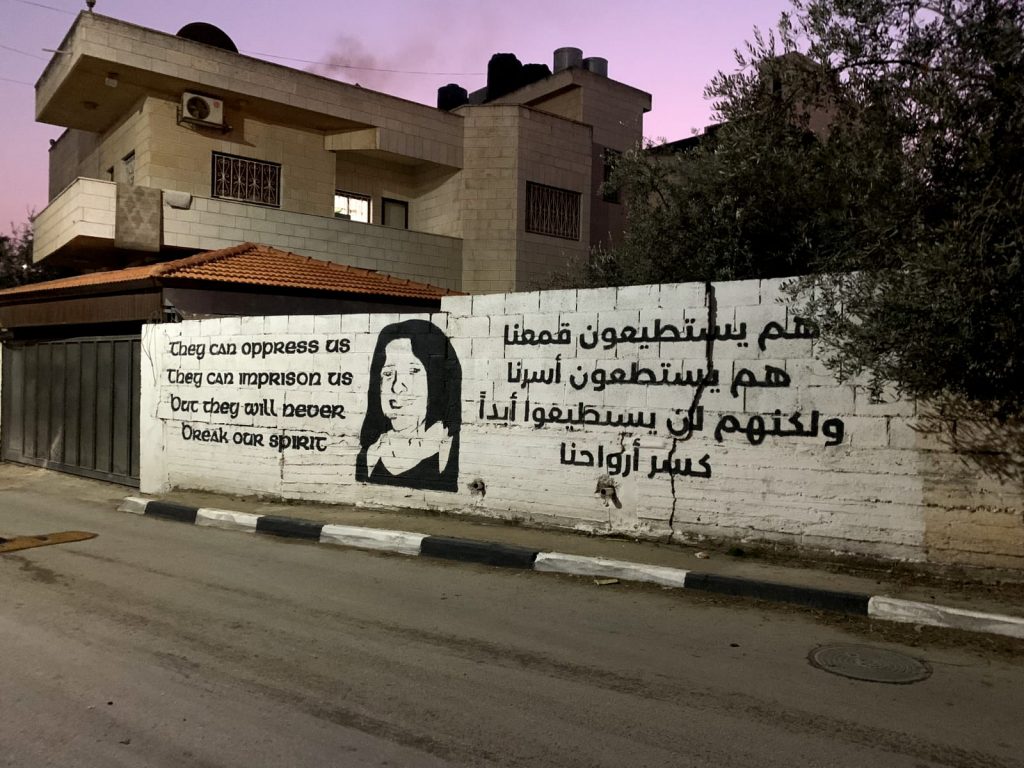
In every camp, on every wall you will find banners commemorating those currently in the jails – personally I have not met one Palestinian who has not had someone in their immediate family or they themselves jailed. All forms of cruelty from kidnap to sexual violence to murder are being inflicted on Palestinians by their occupier for the mere reason they are the colonised people on their land
These struggles are not the same, in Britain, Ireland and Palestine they take their own forms and face increasing degrees of cruelty as they face an increasingly desperate state power– but undoubtedly, they speak to each other. They all struggle against the same brutal imperialist system wherever it lays it’s disgusting hands. This is recognised in my homeland as ordinary people in Belfast’s Republican Falls Road publicly demonstrate in front of murals of our martyrs for those in Israeli and British prisons. In Palestine freed prisoners have declared resolutely ‘we witness your steadfastness and your sacrifices in support of justice and the struggle against oppression, we extend to you our greetings and our pride in you, wishing you victory in your just battle’. Our fraternal comrades in the Palestinian Democratic Youth Union have sent letters stating ‘we affirm that the struggle of these militants is an inseparable part of our Palestinian people’s struggle for freedom, return, and self-determination. The hunger they endure today is an act of resistance and a clear message that prisons do not frighten the free, and that revolutionary will cannot be defeated.’
The free people of the world recognise this as do our opposers, and it is inevitable that this specific struggle returns to the imperial core. This is just one aspect of the return of the ‘imperial boomerang’ as described by Cisé and Fannon, where the empire’s tools of oppression learned abroad will inevitably return to the metropole and be implemented there.
We as communists, as freedom loving youths, must understand this totally and completely. We seek the triumph of the oppressed – oppressed by class, by nation, by religion, by sex. This triumph will only come through overcoming the existing masters and their state, and they won’t give this up without reaching into their darkest and most inhumane depths. We stand today with the prisoners in Britain and in Palestine. Not through words, but on the streets to echo their demands and by letting those inside know we are with them.
Keir Starmer and David Lammy my last words are levelled at you: Your complicity in Genocide will one day be examined in the Hague, but now you face a stark choice, to further entrench yourself in the ranks of history’s oppressors, of bloody Balfour and the hated Thatcher. The other option is that demanded by humanity and those who value life for our brothers and sisters of all lands. Three of the current hunger strikers have now surpassed the duration of that undertaken by the martyr Martin Hurson. Choose to meet the prisoners, choose to meet their demands; because we are the youth, and if you murder one of us, we will not forgive, nor will we forget.
‘If they aren’t able to destroy the desire for freedom, they won’t break you. They won’t break me because the desire for freedom, and the freedom of the Irish people, is in my heart. The day will dawn when all the people of Ireland will have the desire for freedom to show.
It is then we’ll see the rising of the moon.’ – Bobby Sands, 17th March 1981.
Cathal Ó Gaillín is a member of the YCL’s international department and the Scottish Palestine Solidarity Campaign