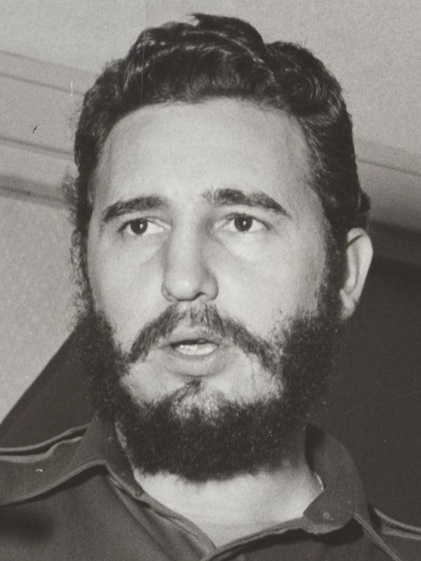
Katrien Demuynck and Marc Vandepitte have really captured the full stature, intellectual brilliance, and heroic revolutionary achievements of El Comandante Fidel Castro Ruz. But not just the revolutionary hero, but a real insight into Fidel Castro the man. Fidel Castro: Beyond the legend shows a man who is larger than life, his personality and motivations. Supported by an authoritative foreword from renowned journalist Ignacio Ramonet, this book provides an indispensable account of how a small Caribbean island, under Castro’s visionary and revolutionary leadership, triumphed after centuries of colonial and neocolonial chains to become a beacon of sovereignty, socialism and peace.
Demuynck and Vandepitte trace Castro’s journey with meticulous rigor. Beginning with his childhood in Birán, it becomes clear how his early environment forged his unyielding moral compass. Growing up on his father’s estate where the presences of foreign power was tangible, the young Fidel was acutely attuned to the stark inequities surrounding him. These included the brutal exploitation of sugar cane workers and Haitian seasonal labourers by US-owned monopolies like the United Fruit Company. An incident occurred when Fidel defended Serrucho, one of the Haitan workers being beaten by a guard. Although the guard drew his revolver Fidel refused to step aside, showing immense courage at a young age. It was here he began to see the wider system of exploitation in Cuba, with the power being with the managers of the American Sugar companies, who had US soldiers to enforce their will.
Later on, the authors capture Castro’s political awakening at the University of Havana and his transition from radical student to rebel leader. His political activity in University meant that he often carried a weapon. But despite this dangerous environment he continued to assert himself against injustice and corruption in Cuba, as his political convictions took precedence over everything. We read that once graduated, Fidel’s political and moral principles meant he rejected life as a wealthy lawyer and established himself as a lawyer for the poor at great sacrifice to himself and his young family. This chapter also gives us an insight into his political work in the Party Ortodoxos, which exposed the corruption of the Cuban regime, but how Fidel started to think of a broader strategy of social transformation. It was during these years of intense study and political activism that he became convinced that a decisive break with the current system was necessary.
The historic 1953 attack on the Moncada Barracks, a daring attempt to ignite a national uprising against Fulgencio Batista’s US-backed dictatorship, although failed initially is seen as the moral starting shot of the revolution. When captured and put on trial, Castro transformed his defense into a indictment of the regime, culminating in his world-historic speech, “History Will Absolve Me”. As the book eloquently highlights, Castro possessed the singular ability to turn temporary military setbacks into resounding political victories.
On the Isla de Pinos, Fidel turned incarceration into a school of organisation. By founding the Abel Santamaría Ideological Academy, he transformed the prison cell into a university of political economy, history, and philosophy. This unwavering optimism and strategic clarity was shown during the perilous 1956 Granma expedition. Landing in swampy, hostile territory with only a handful of survivors and seven rifles after the disastrous ambush at Alegría de Pío, Fidel’s famous declaration at Cinco Palmas, “Now we will definitely win the war!” testifies to his immense revolutionary spirit and strength.
The chapters dedicated to the guerrilla war in the Sierra Maestra offer a masterclass in revolutionary strategy. Demuynck and Vandepitte document how Castro forged an unbreakable organic bond with the Cuban peasantry. By establishing strict revolutionary discipline, ensuring every piece of food was paid for, providing medical care, and treating captured enemy soldiers with unprecedented humanity, Castro built a moral superpower. Supported by the urban clandestine network and his comrades Che Guevara, Camilo Cienfuegos, Raúl Castro and Celia Sánchez, Fidel’s rebel force achieved the impossible, defeating Batista’s heavily armed, US-supplied military in under two years. The authors have managed to capture how Fidel made the impossible possible.
Beyond the armed struggle, the biography shines a brilliant light on Fidel Castro’s revolutionary achievements. His leadership was a decisive factor, and whilst he never sought being in government, he was thrust into leadership as the confrontation with the US and counterrevolutionaries became sharper. Under his leadership, Cuba abolished illiteracy in a single year, built a world-renowned universal healthcare system, and completely reorganised society for the benefit of the working masses. As the book rightly highlights, this modest developing nation of ten million inhabitants went on to export more medical personnel globally than the entire World Health Organization. Fidel’s unwavering anti-imperialism stood firm against twelve US presidential administrations, enduring the longest economic blockade in history, the Bay of Pigs invasion, and the brink of nuclear catastrophe, without ever compromising Cuba’s national sovereignty and socialist programme.
Furthermore, the authors write about Castro’s magnificent internationalism, most notably Cuba’s decisive military and humanitarian interventions in Africa, which proved instrumental in defeating the South African apartheid regime and securing Angolan and Namibian independence. As Fidel said, to be an internationalist was to pay ones own debt to humanity. Ignacio Ramonet in his foreword rightly identifies Fidel as a visionary ahead of his time, predicting the rise of the Global South and a multipolar world order long before those concepts entered mainstream discourse.
In the final chapter ‘ideas are more important than weapons,’ it goes into the many speeches by Fidel, how he spoke the language of his people and meticulously to the detail plotted the plans for the revolution. As the authors point out, his detractors describe his speeches as indoctrination. However, Fidel called on Cubans to never accept anything from anyone without understanding it fully themselves.
I found writing and reading this book in the year of his centenary extremely motivating and inspiring. The authors really got behind the icon and legend that Fidel was, in contrast to the Western caricatures of Fidel and wrote about Fidel the man, the revolutionary and above all a man of immense principle. Despite the difficulties that Cuban’s face today, with the illegal financial, commercial and economic blockade imposed on the country by the US, the inclusion of the US’ spurious States Sponsor of Terrorism list and the disgraceful oil blockade, Fidel’s legacy lives on. The system in which he fought for lives on. It shows us that now more than ever, we must stand with Cuba, for not only Cuba but the rest of humanity relies on us to.
Fidel’s legacy, as this magnificent book proves, remains a shining light that no enemy can ever extinguish.
Micaela Tracey-Ramos, is a member of the YCL’s Merseyside Branch