[This is the second of a 3-part series, find the first article here]
ach glacfad fees ó rí na gcroppies
cleith is píc chun sáite
‘s go brách arís ní ghlaofar m’ainm
sa tír seo, an spailpín fánach
The events of Easter 1916 were the largest and most impactful act of struggle for Irish National Liberation in the era of capitalism since the United Irishmen rebellion of 1798, part of the wider series of Bourgeois revolutions in that period. The similarities abound: both operated under the auspice that England’s difficulty is Ireland’s opportunity, both sought foreign aid from the occupier’s enemies of France then later Germany, and both contained diverse characters from secret societies (The United Irishmen and the Irish Republican Brotherhood), multi-confessional leaders and rebels as epitomised by Watty Graham of County Derry in 1798 and the aforementioned Tom Clarke. Indeed, both featured episodes of slaughter at the hands of a better funded, armed and technologically superior enemy at Vinegar Hill and in Dublin. However, while the rebellion of 1798 bore no fruit in the lifetime of those who partook, the rebellion of 1916 did. A closer examination of the intervening period, of particular relevance to workers in Britain, gives insight to this.
The advance of industrialisation and the increasing need for labour in Britain’s newfound centres of production is well known, and also the fact that this was buoyed by the cheap import of raw goods such as cotton from the colonial empire. However, what is less known is the role Irish labour played in this and the ethnic division among workers engendered by the ascendant capitalist class. As the first colony, Ireland has been continually subject to oppression and restricted development since the 17th century. From Cromwell to the penal laws this is well known and provided the capital accumulation and skill set necessary for a nascent Capitalist class in Britain to be able to terrorise and thieve from all corners of the globe. The early signs of enforced nondevelopment were also present, such as the Navigation act with tariffed Irish Exports to Britain but not vice versa. Nevertheless, food exports, pushed by absentee landlords, still made up a large part of the Irish economy even during the famines induced following Blian an Áir or the ‘Great Frost’ of 1740/41. This caused the death of 400,000 and emigration of 150,000, but in general the population continued to rise and the Ango-Irish aristocracy extracted political concessions such as Grattan’s parliament when offered a limited self-governance for the Anglo-Irish aristocracy, without the need to include even the multi-confessional proto-bourgeois elements or indeed the masses of Irish peasantry. 26
Inspired by the ideals of the great progressive revolution in France, the United Irishmen under Protestant lawyer Theobald Wolfe Tone launched their rebellion in 1798 in various localities, with the rebels formed of diverse groups such as catholic peasants and Presbyterian merchants. The ultimate political defeat of this rebellion was codified in the 1801 Act of the Union which withdrew all matters concerning Ireland to governance by Westminster. On the economic front this was true also, as any genesis of native industrial development was strangled in the crib by the act of Union and enforcement of Free Trade between Britain and Ireland. This annihilated the local flax trade concentrated in Ulster and associated linen production through the import of both slave-picked American and Indian cotton. The nascent Dublin craft industry was virtually wiped out through competition with a further developed industry in Britain, not helped by the new political arrangement in which even this section of an Irish Bourgeoisie’s interests was an afterthought.
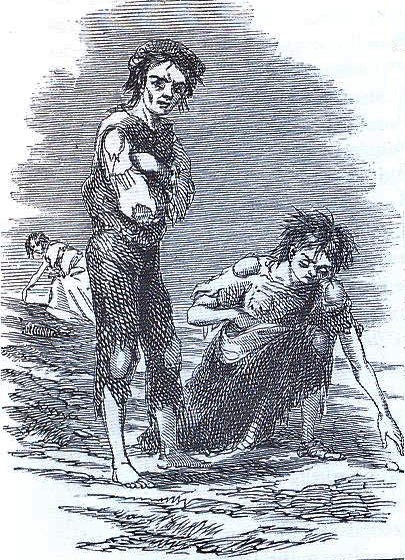
Couple this with the large scale absentee landlordism of British based gentry (such as Lord Castlereagh of Napoleonic War fame) that further sought to use agricultural land to feed a growing British export market, and was enforced on the ground by an Irish based comprador class that forced the largely rural population into increasingly smaller plots and vulnerable forms of sustenance farming, often merely a ‘sorry hut without partitions, and a potato patch just large enough to supply them’ as described by Engels – a fact that came to a tragic head during the Genocide known as An Górta Mór (1845-52). The events of that period are harrowing and deeply felt to this day , Ireland’s population has still never recovered to pre-famine levels, and nations of contemporary population at the time such as Egypt now comprise over 107 million. Three points are most pertinent to our discussion: Out of a population of 8 million – 1m are estimated to have died and a further 2m emigrated, the Irish language was pushed to near extinction and throughout all of this Ireland exported vast quantities of food (enough to feed the population) to England as her economic place as a subject of the Empire dictated. 14 5 30 29 33
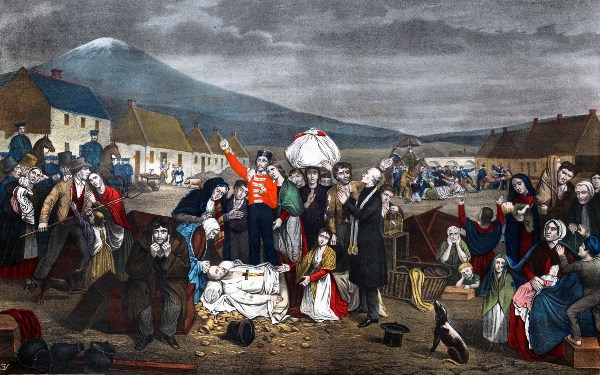
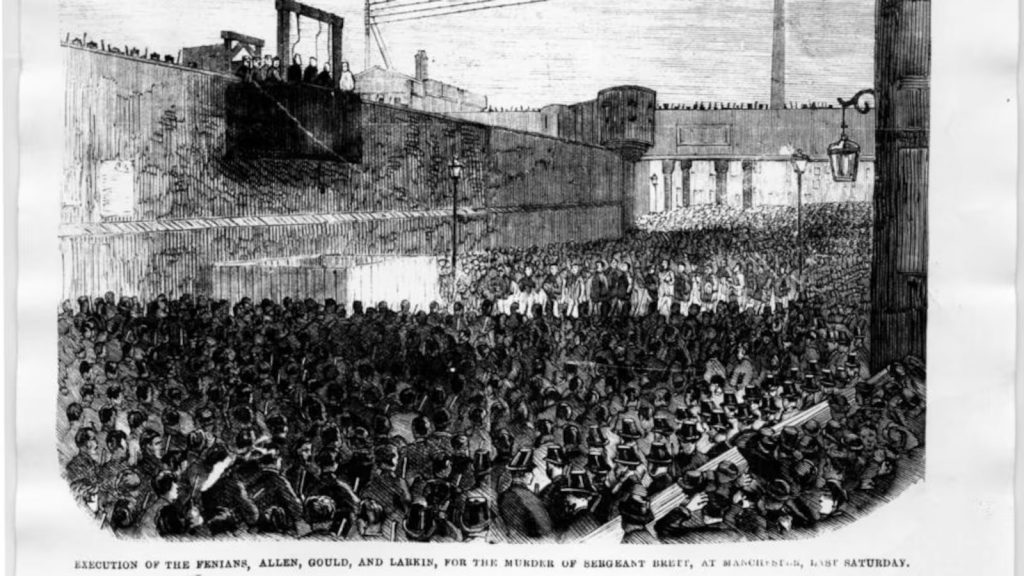
The majority of these downtrodden sought not a better life but mere survival in North America, but many travelled to Britain, further driven by mass evictions by the absentee landlords to relieve them of any pauper’s duties following the repeal of the corn laws. These ‘despairing flight of starving Irish to England filled basements, hovels, workhouses in Liverpool, Manchester, Birmingham, Glasgow with men, women, children in a state almost of starvation’, numbering 806,000 by 1861. Notably this is merely a count of the Irish born, with second and even third generations of emigrants undoubtedly a much broader number. Many of these continued the struggle for freedom that was carried out by organisations such as the Fenians or the Land League .The Irish National Liberation movement at this time was in contrast to most bourgeois or even aristocratic led national movements at the time for example in Hungary or Poland, and instead characterised by ‘socialist […] leanings and as a lower orders movement.’ as described by Marx to Engels in the midst of the trial of those who went on to become the Manchester Martyrs. 25 35
These processes of emigration enforced by the land clearances of inhabitants in favour of livestock and grains pushed Ireland’s population to a low of 4 million, as those in Britain found themselves faced with sections of the British working class in a ‘common front […] against Ireland’ with the ruling classes. James Connolly provides an excellent case study in this regard. 33 17
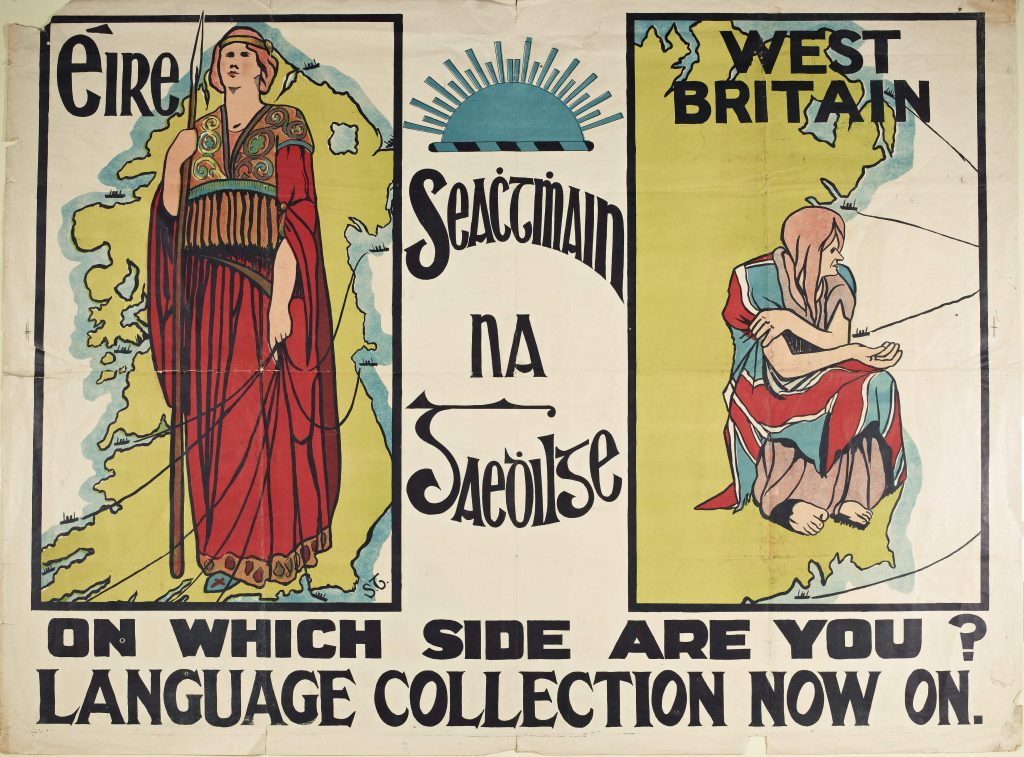
Born in 1868 in Edinburgh’s Cowgate, an area that can only be described as a subterranean Irish ghetto, with bridges leaping over it towards the royal mile and where only 15% of the population found regular employment from the single room dwellings where 72% of the residents found housing. The timeless biography by C. Desmond Greaves examines all aspects of Conolly’s life in detail. From the hostile environment all Irish emigrants encountered during an epoch of ‘scientific racism’ and alienisation based on the majority catholic religion of the immigrants. In adulthood he became one of Edinburgh’s leading trade union and socialist agitators, fighting elections to give voice for the toiling masses against Liberals and Tories who conspired to split the city between themselves. His homeland and people never left his mind however and far from being a contradiction, the struggle for a revolution in Ireland was epitomised in his later famous slogan ‘The cause of labour is the cause of Ireland’. Eventually returning to an Ireland in the midst of renewed national and growing revolutionary sentiment as typified by the ‘Gaelic Revival’ that rejected the subjugation of Irish national culture into a regional ‘West British’ culture with movements such as the Gaelic League focusing on the native language, the Gaelic Athletic Association on native sports and works of literary figures such as W.B Yeates that drew on Irish folklore and tradition. Connolly organised in Dublin and Belfast, intertwined with periods as an organiser in Britain and America. 12 31
It is then he wrote ‘The Reconquest of Ireland’, which still provides both inspiration and the road map for those struggling for Ireland’s freedom in total – to put an end to the state of affairs where Irish workers are ‘the slave of capitalist society, [and] the female worker is the slave of that slave.’ 13
Cathal Ó Gaillín, is a member of the YCL’s Lanarkshire Branch and International Department
This article is the second in a 3-part series. Look out for the final part coming soon.
[1]
[2]
‘30 women, five years: the cost of silence in the face of male violence’, Impartial Reporter. Available: https://www.impartialreporter.com/news/25959295.bernadette-mcaliskey—30-women-five-years-cost-silence/
[3]
‘CAIN: Proclamation of the Irish Republic, 24 April 1916’. . Available: https://cain.ulster.ac.uk/issues/politics/docs/pir24416.htm
[4]
‘Chronology of the Easter Rising | Century Ireland’. Available: https://www.rte.ie/centuryireland/articles/chronology-of-the-easter-rising
[5]
‘Constitution of the United Irishmen, 1797 – Cartlann’. Available: https://cartlann.org/authors/united-irishmen/constitution-of-the-united-irishmen-1797/
[6]
‘Coventry family wins legal battle for Irish wording on gravestone | Religion | The Guardian’. . Available: https://www.theguardian.com/world/2021/feb/25/coventry-family-overturns-ban-on-gaelic-wording-on-gravestone
[7]
‘Economic Manuscripts: Capital Vol. I – Chapter Twenty-Five’. . Available: https://www.marxists.org/archive/marx/works/1867-c1/ch25.htm#S5f
[8]
‘Food Exports from Ireland 1846-47 – History Ireland’. Available: https://historyireland.com/food-exports-from-ireland-1846-47/
[9]
J. Glass and P. A. L. Editor, ‘“I’m a free mawn”: Kneecap’s Mo Chara celebrates as UK government loses appeal over rapper’s terror charge’, The Irish News. Available: https://www.irishnews.com/news/northern-ireland/kneecap-rapper-mo-chara-wont-face-new-terror-trial-after-cps-lose-appeal-MTU5FCJX4FFNNNOWVN6WGQN7YE/
[10]
By, ‘Ireland’s Red Troubadour’.. . Available: https://tribunemag.co.uk/2019/01/irelands-red-troubadour
[11]
‘Irish Immigration Impact on Scotland | PDF | Scotland | Scottish People’. . . Available: https://www.scribd.com/doc/152217519/Menace-of-the-Irish-Race-to-our-Scottish-Nationality
[12]
‘James Connolly – James Connolly Society’. . . Available: https://jamesconnollysociety.com/james-connolly/
[13]
‘James Connolly: The Re-Conquest of Ireland (1915)’. . . Available: https://www.marxists.org/archive/connolly/1915/rcoi/index.htm
[14]
‘Key Events and Timeline of 1798 Rebellion’. Accessed: Apr. 02, 2026. . Available: https://1798centre.ie/history/timeline-of-1798/
[15]
‘Learn | Ireland’s Great Hunger Museum’. . . Available: https://www.ighm.org/learn.html
[16]
‘Lenin: The Discussion On Self-Determination Summed Up’. Accessed: Apr. 02, 2026. . Available: https://www.marxists.org/archive/lenin/works/1916/jul/x01.htm
[17]
‘Letters: Marx-Engels Correspondence 1869’. . . Available: https://www.marxists.org/archive/marx/works/1869/letters/69_11_29-abs.htm
[18]
‘Letters: Marx-Engels Correspondence 1869’. . . Available: https://www.marxists.org/archive/marx/works/1869/letters/69_12_10-abs.htm
[19]
M. Staines, ‘“Most of my friends are emigrating” – Young people priced out of tourist hotspots’, Newstalk. . . Available: https://www.newstalk.com/news/most-of-my-friends-are-emigrating-young-people-priced-out-of-tourist-hotspots-1482576
[20]
The Late Late Show, ‘My Generation…’ Blindboy Boatclub – The Rubberbandits | The Late Late Show | RTÉ One, (Jan. 09, 2016). . [Online Video]. Available: https://www.youtube.com/watch?v=2v1kuaWCj1U
[21]
‘National Library of Ireland – 1916 Exhibition’. Accessed: Apr. 02, 2026. . Available: https://www.nli.ie/1916/exhibition/en/content/sevensignatories/
[22]
‘Neglect in the North of Ireland’, Ebb Books. . . Available: https://www.ebb-books.com/books/p/neglect-in-the-north-of-ireland
[23]
K. Mellett, ‘“No Irish, No Blacks, No Dogs”: Irish Times readers recall seeing notorious signs in Britain’, The Irish Times. . . Available: https://www.irishtimes.com/ireland/social-affairs/2024/05/06/no-irish-no-blacks-no-dogs-irish-times-readers-recall-encountering-notorious-signs-in-britain/
[24]
Walter Lawler Archive – Regular Video Uploads, Nora Connolly O’Brien Interview 1965, RTE, (Nov. 03, 2025). Accessed: Apr. 02, 2026. [Online Video]. Available: https://www.youtube.com/watch?v=ann0OF0Br38
[25]
‘On the Irish Question by Karl Marx’. . . Available: https://www.marxists.org/archive/marx/works/1867/12/16.htm
[26]
‘On this day in history… a forgotten Irish Famine started. | Radboud University’. . . Available: https://www.ru.nl/en/research/research-news/on-this-day-in-history-a-forgotten-irish-famine-started
[27]
‘Orange Lodge makes fresh bid for Stonehaven parade’, BBC News. . . Available: https://www.bbc.co.uk/news/articles/c5y9dv70znzo
[28]
‘Political Resolution of the 26th National Congress’, Communist Party of Ireland. . . Available: https://communistparty.ie/en/policies-documents/political-resolution-of-the-26th-national-congress/
[29]
‘The Agricultural Proletariat’. . . Available: https://www.marxists.org/archive/marx/works/1845/condition-working-class/ch12.htm#ireland
[30]
G. O’Brien, The economic history of Ireland from the union to the famine. London, New York [etc.] Longmans, Green and co., 1921. . . Available: http://archive.org/details/economichistoryo00obri_2
[31]
C. D. Greaves, The life and times of James Connolly. Croydon: Manifesto Press, 2018.
[32]
‘The National 1798 Rebellion Centre – Plan Your Visit’. Accessed: Apr. 02, 2026. . Available: https://1798centre.ie/
[33]
C. Ó Grada, ‘The population of Ireland 1700-1900 : a survey’, Annales de Démographie Historique, vol. 1979, no. 1, pp. 281–299, 1979, doi: 10.3406/adh.1979.1425.
[34]
E. McCartan, ‘The Struggle to Maintain and Build Our Neutrality Heats Up’, Socialist Voice. . . Available: https://socialistvoice.ie/2026/03/the-struggle-to-maintain-and-build-our-neutrality-heats-up/
[35]
P. B. R.- poweredbyreason.co.uk, ‘The tale of the Manchester Martyrs’, People’s History Museum. . . Available: https://phm.org.uk/blogposts/the-tale-of-the-manchester-martyrs/
[36]
‘The world can criticise Kneecap, but they have started something’, May 2025, . . Available: https://www.rte.ie/culture/2025/0503/1510512-the-world-can-criticise-kneecap-but-they-have-started-something/
[37]
‘Weapons of war went through Ireland’, The Ditch. Available: https://www.ontheditch.com/weapons-of-war-checked-shannon-airport/
[38]
‘YCL International Department Condemns Not Guilty Verdict of “Soldier F”’, Young Communist League of Britain. . . Available: https://ycl.org.uk/2025/11/01/ycl-international-department-soldier-f/
[39]
‘Young People Considering Emigrating for Better Life’, National Youth Council of Ireland. . . Available: https://www.youth.ie/articles/young-people-considering-emigration-for-better-quality-of-life-than-in-ireland/
[40]
Liberty Hall bombarded house Beresford Place May 17 [1916] – Digital Repository of Ireland. doi: https://doi.org/10.7486/DRI.3b591882v.