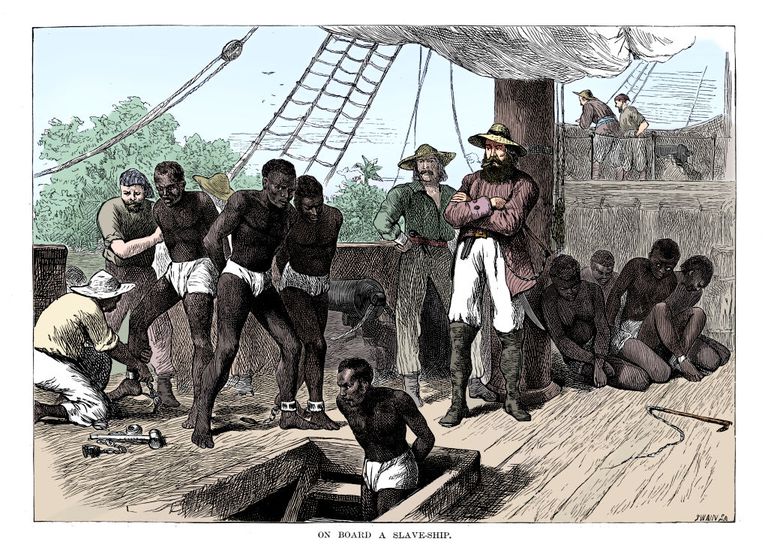
March 25 marks the day of remembrance for victims of slavery and the Transatlantic slave trade. Millions of people were taken from Africa by European powers to be exploited for the rest of their lives in the Americas. The racist ideologies used to justify and enable this slave trade leave a long legacy that must still be challenged today, as we continue the struggle to end all forms of slavery as well as the continued exploitation of Africa by Western corporations and governments.
The incomplete struggle against slavery
The day of remembrance was established as March 25th due to this date, in 1807, being when the Abolition of the Slave Trade Act was passed in Britain. While beginning the end for the Transatlantic slave trade, this act did not abolish slavery itself. Slavery persisted in the USA for almost 60 years afterwards, with the southern slave states seceding from the USA in 1860 in attempt to preserve their slave-based economic system.
Even with the defeat of the southern Confederacy in the US Civil War, the struggle against slavery in North America was not over. The 13th Amendment to the US Constitution, passed 1865, outlawed slavery except as a punishment for a crime – an exception that continues to this day. Prison labour is widespread across the USA, a country stained with the accolade of largest prison population in the world. Of those imprisoned in the USA, black people make up a disproportionately high amount; around 1 in 3 prisoners are black, despite making up only 13% of the US population.
We must be under no illusion that the Abolition of the Slave Trade Act was passed out of the benevolence of the British ruling class; changes such as these only result from years of concerted struggle. For example, 1807 was only 4 years after the establishment of the Republic of Haiti – the first country to be founded by former slaves.
The founding of this Republic only came after over a decade of fighting in the Haitian revolution, forcing the French’s hands.
With the retreat of Haiti from the global sugar market after the Revolution, Cuba would become one of the largest sugar producers, slavery continuing in Cuba until it was abolished by the Spanish Empire in 1886. Poor treatment and exploitation of plantation workers would continue in various forms in countries like Cuba for a number of decades after slavery was abolished. For example, after slavery was abolished in Cuba, thousands of Chinese indentured servants would be put to work on the island.
Racism and capitalism: Enabling the slave trade
The role of racism in enabling and perpetuating the slave trade must be properly understood. Racism was not the sole motivator for carrying out the slave trade – economic interest played a significant role – but it is an essential part of it.
The early capitalist European powers had found a wealth of resources in the Americas to carve out and exploit, but as is always the case, the powerful owning minority needed a mass of workers to do the labour for them. While wage labour was profitable, the European colonists saw even greater profits to be made through slave labour. The fact that slaves would work for them for life and were completely under their control offered greater guarantees of long-term profit maximising – and the political and economic power that comes with it.
This is not to downplay the significance of racism in the slave trade. Quite the opposite, it is to highlight the inherent interconnection of racist attitudes with economic interests under capitalism. Out of the underlying capitalist system came the incentive for European powers to carve up the world and exploit its people and resources. Out of this colonial mindset, where other races and people were not to be better understood and cooperated with, but used as means to an end, racist attitudes were encouraged and incentivised.
It is not as if the birth of capitalism and European colonialism created racism, but existing racist ideas influenced the form that this economic system took and how Europeans (both worker and owner) viewed the colonial project and enslavement of Africans. In turn, this economic system shaped a racist politics and culture. The European worker was encouraged to see themself as different to the African slave. They could justify their own exploitation as being far less than that of the slave, and enslavement of Africans as natural due to racist ideas of “lesser peoples” or the “happy slave”.
The racist ideas encouraged by, and useful to, capitalism did not dissappear with the abolition of slavery. Two centuries since slavery began to be dismantled, black people in the USA are still dealing with the legacy of the trade, Britain is yet to properly address its history of colonialism and empire, and racist ideologies are perpetuated as false solutions to today’s economic problems.
In the USA, the abolition of slave labour did not eliminate anti-black racism overnight. The beliefs that had perpetuated slavery persisted, taking shape in the form of Jim Crow segregation. It would take one hundred years of struggle by black Americans from the abolition of slavery in the 1860s until the Civil Rights Act of the 1960s. Even now, black Americans are living with the impact of racist city planning laws, generational poverty, and overrepresentation in the prison population.
Let us not forget similar policies of racial separation in other countries, such as apartheid South Africa, and even today in the West Bank in Palestine.
In Britain, education on the slave trade and British empire is insufficient and inconsistent. There is a lack of understanding amongst many workers of where black British people came from and why many of them or their families came to be living here. The fact that many of these people came from colonies that were, until relatively recently, within the British empire is too often forgotten.
Where now?
As communists, we must further our work to educate our class on the slave trade, empire, and racism. Particularly we must expose the relationship between racist ideas and the capitalist system, joining up the struggles against racism and against imperialism – as these struggles do not just overlap, but in fact are one and the same.
We must highlight the flaws in racist explanations for our current poor conditions – such as blaming immigrants for poor housing and wages – which draw on old racist ideas and continue to ignore the role of empire. The hypocrisy of those who, on the one hand, aim to win votes by blaming immigration, while at the same time advocating military, environmental, and economic positions that create refugees and economic migrants, must be brought into the light.
As part of our anti-imperialist work, we must challenge the continued exploitation of Africa by imperialist powers. Monopoly corporations extract resources from Africa to be sold worldwide: the money built off the backs of African workers, including in some places children, going to private owners not the people of these countries. Western interventionism must be challenged as a part of this. Take Libya, where Western powers conspired to overthrow Gaddafi, destabilising the country and resulting in the return of the slave trade in Libya.
The political consciousness within our trade unions must be raised, such that members are not simply fighting defensive battles for improved wages and conditions, but engaging in a long-term struggle against imperialism. Workers must be able to recognise the role of British-based corporations in the continued exploitation of Africa and elsewhere, and be won over to a political struggle to dismantle the legacy of colonialism and empire.
This work must be enhanced by anti-racist and anti-fascist campaigning in our communities. Such campaigning must go beyond reactive mobilisations against the far-right, expanding to long-term organising that adresses the causes of racism and fascism in the first place.
In our schools and universities, young communists must be at the forefront of efforts to ensure strong, consistent education on the British empire and slave trade, and making those links to capitalism that the education system is often unwilling to acknowledge. We should be teaching our peers ourselves as much as we are fighting to improve what is taught in the classroom.
The Transatlantic Slave Trade must be remembered, not as a bygone era from which humanity has improved, but as a key part of the development and expansion of European capitalism. Its impact remains, and its consequences are yet to be completely tackled.
Britain’s colonial legacy can only be reckoned with by a politically conscious workers movement in an anti-imperialist united front. One that is capable of tying together the fight against racism, for proper education on slavery, and for the overthrow of capitalism.
Philip English, is Editor of Challenge