In May 1936, the Popular Front Government of Spain took power, comprising of Communists, Socialists, and Liberals, to defend the advancements of the Spanish Second Republic against the rising power of fascism. In response, fascist elements attempted a coup against the government, this was only partially successful and so began the Spanish Civil War.
At this time, Spanish workers were taking up arms in order to defend themselves against fascism. They were isolated by the non-intervention of France and Britain and facing far superior firepower as the Spanish fascists were supplied with arms, tanks, and aeroplanes by their fascist counterparts in Italy and Germany.
The unity of the Spanish workers sent ripples around the globe as people endeavoured to put aside their differences to come to the aid of the Spanish Republic. The Communist Party echoed the calls of the Spanish workers and stated its intent to form a popular front against fascism in Britain and to demand an end to non-intervention.
When looking at any policy, to assess its effectiveness, it’s vital to look at not just the national impact of it, but the local impact and assess how it was taken up by the base. It’s true that the popular front in Britain was more effective in some places than it was in others, however one of the places in which it was perhaps most effective and cohesive was in Aberdeen, the Scottish city which had the largest fascist presence at the time.
By the late 30s, the Aberdeen Communist Party had immersed itself in not just the political and economic life of the working class in the city, but the cultural too. Many Aberdonians made their way of an evening to what was known by some as The Plaza, a dancehall which was the premises of the National Unemployed Workers Movement (NUWM), a body seen as Communist affiliated. So, while the unemployment rate of Aberdeen was not as high as other Scottish cities, sitting around 15%, the NUWM was a part of the everyday life of Aberdonians in a way that political movements often struggle to become.
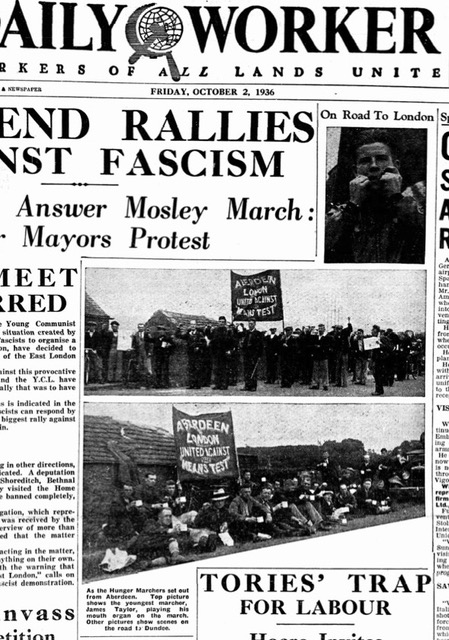
This agitation around unemployment led to around 30 people leaving from Aberdeen for the 1936 hunger march. The accounts from the hunger march at the time state that only six or so of that contingent were members of the Communist Party and that many were previously unpoliticised people who had joined simply to demand an end to the means test. Hundreds of Aberdonians came to see off the hunger marches, showing that this was a movement that stretched beyond those who were already active trade unionists and socialists.
By this point, the unity of the working class in Aberdeen was already greater than in other parts of the country. The Trade Union Council (TUC) aligned Unemployment Association, which was set up to curb the influence of the NUWM, was regularly working alongside the NUWM in Aberdeen. They had even selected a Communist delegate to the Aberdeen Trades and Labour Council! This was despite the TUC requesting that trades councils did not elect Communists to positions. This reflected a pattern of the trade union movement engaging with the NUWM in a manner in which they didn’t elsewhere. For example, John Lennox was an official delegate to the 1936 hunger march from his Scottish Painters’ Society branch.
Following assurances that the people of Aberdeen would support them, workers aboard the Spanish SS Eolo went on strike while docked in Aberdeen. The government of Spain had awarded an uplift in the pay of seamen, however the companies refused to pass this on to the workers. The Aberdonian trade unions set up a fund to support those on strike. This forged a very deep connection between the people of Aberdeen and the Spanish workers, in the words of Bob Cooney “they… declared themselves Aberdonians in heart and soul before they left.” While the Eolo was docked in Aberdeen, there were rallies jointly held by the Independent Labour Party, the Labour Party, The Communist Party and the NUWM to protest not only against the unemployment policy of the government, but also in support of the Spanish Republic.
Support for the Spanish Republic and the unemployed workers movement were two factors which made Aberdeen’s opposition to fascism so strong. Oswald Mosely’s British Union of Fascists, and their paramilitary wing The Blackshirts, had targeted Aberdeen due to the position of WKAJ Chambers-Hunter, laird of Tillery, who lived in Aberdeenshire, rather than Aberdeen being chosen for being a particularly “fascist town”.
The victories of the Blackshirts in Aberdeen were few and far between, something particularly impressive given the amount of protection they were initially given by the police. Dramatic scenes such as anti-fascist workers stopping their rallies at the Music Hall by gaining entry and jeering the speakers off the stage, paper sales of Action being interrupted, and their spontaneous outdoor meetings ending in the black shirts of the Blackshirts being stained with grass, rendered fascist organising in Aberdeen redundant.
While when looking at the history of antifascism, there’s a tendency to look at big moments such as the Battle of Cable Street and pin the victory against fascists purely on a single moment. It’s vital that we look at what led to these moments being possible and what comes after. Phil Piratin, Communist MP for Stepney, in his book Our Flag Stays Red, emphasises the importance of the tenants movement in taking away the social base of fascism, by involving those who wouldn’t normally be friends of the Communists into struggle, and showing them that their true enemy is not Jewish people, Muslims, nor migrants, but it’s the landlord, CEO, and politicians in the pocket of billionaires.
In Aberdeen, the unemployed movement was an important part of politicising unemployed people who were vital in raising the alarm when unannounced fascist rallies sprung up around Aberdeen, as were unionised transport workers who would travel the city as part of their work.
The role of the state is a significant point of study in the study of antifacism. As in other parts of the country, the police generally favoured the fascists over those who opposed them. They provided protection to their protests, they arrested those who the fascists pointed out to arrest, and they clamped down on socialist organising. However, in Aberdeen there was eventually a shift in this. The legend goes that the leader of the fascists Chambers-Hunter called an inspector an illegitimate child (or a word to that effect) and after that the police distanced themselves from the fascists. Whether this is true or not is somewhat immaterial as there is little doubt that the rapid shift in this policing policy was impacted by the steadfast campaigning and pressure from antifascists in Aberdeen. Following the decrease in police protection, the Blackshirts quickly crumbled in the face of their opposition.
From the dedicated work of Communist, Socialists, and trade unionists outlined above, it is no surprise that 19 Aberdonians would go to Spain to directly confront fascism. Their sacrifice is honoured in the Aberdeen Trade Union Council office “John Londragan House,” where the memorial is housed. These 19 Aberdonians were people who had been deeply involved in the NUWM, solidarity with the Eolo and fighting against the Blackshirts.
The story of this period of struggle in Aberdeen can be summed up as unity against the odds. Nationally, the Labour Party were deeply opposed to joining with the Communists in demanding an end to non-intervention in the Spanish Civil War or working with Communists to defeat the government’s policies on unemployment. To the extent that they expelled the Socialist Labour League for joining the popular front. Yet, in Aberdeen we saw the opposite. In Aberdeen, Socialists, Communists, and trade unionists were able to put aside differences and agree on the basics, that people had a right to work and that our government shouldn’t leave the Spanish people to the mercy of fascism. This was a unity that was not forged through meetings with no connection to ordinary workers, but a unity that was forged in struggle and tempered through struggle. The makeup of the trade union movement in Aberdeen was one in which many smaller trade unions had to work together, rather than being dominated by one or two large unions.
The unity went to the extent that the Labour Party were willing to stand up for local working people when the Labour leadership were urging them to abandon the popular front. When urged not to attend a conference for unity in 1939 by Arthur Woodburn, the Aberdeen Labour Party responded, “the Aberdeen Party are quite capable of looking after the interests of the labour movement in Aberdeen and … [if your] advice is required it will be asked for”.
While it would be foolish to try and claim the conditions of 1936 Aberdeen are directly replicable today, it would be similarly foolish to dismiss the learnings from it. In any discussion about unity, it is vital that we look at the local conditions from which unity arises in order to create this unity again. Unity is not something which is handed down from above nor is it something that naturally arises. It is something that must be struggled for.
Josh Morris, is a member of the YCL’s Aberdeen Cadre Group
This is an article from a larger pamphlet called Building Working Class Power: Changing Scotland, available at: https://shop.communistparty.org.uk/?q=pamphlets/building-working-class-power
Further reading-
Labour History Review- Unity from Below? The Impact of the Spanish Civil War on Labour and the Left in Aberdeen and Dundee, 1936–1939- by Malcolm Petrie
Proud Journey- A Spanish Civil War memoir- Bob Cooney
Voices from the Spanish Civil War; personal recollections of Scottish volunteers in Republican Spain 1936-39- Ian MacDougall
Voices from the hunger marches: personal recollections of Scottish hunger marchers of the 1920s and 1930s- Ian MacDougall
Fascism in Aberdeen: street politics in the 1930s- Liz Kibblewhite (Aberdeen People’s Press)