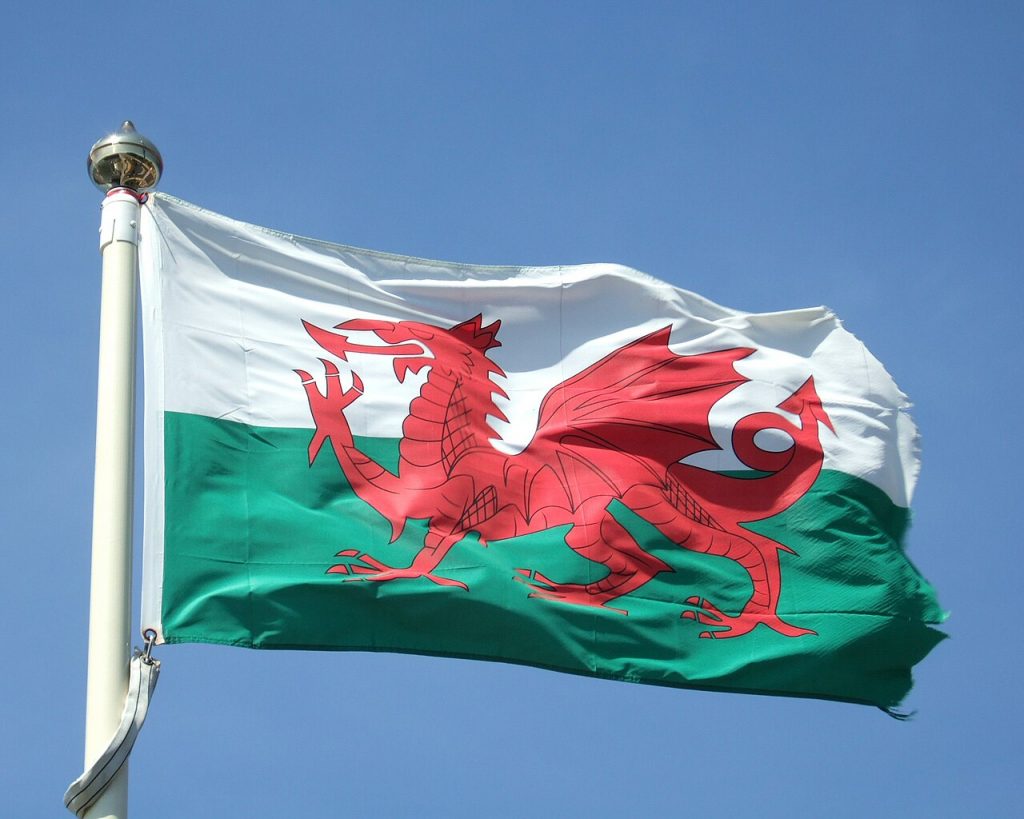
Throughout my childhood St. David’s Day was celebrated every year in school with traditional dress for the girls and rugby shirts for the boys with the occasional dai cap floating about. We’d have competitions putting our creative skills to the test and I managed to come third one year with my effort of dressing up a leek in a custom-made rugby kit, well my mam won me third..
However, St. David’s Day is an important day in the Welsh calendar because of the suppression that Welsh culture and the language have faced over hundreds of years. [1] The Welsh culture continued to be mocked by the British ruling class, even accusing the Welsh language as being the reason for lawlessness! [2] So their solution was to shame any child in school who dared to speak Welsh.
The Welsh Language Act 1967 permitted the use of the Welsh language in legal proceedings and has been a continuing battle to ensure the Welsh language, not only survives, but grows in numbers who use it in their everyday lives. Notably, in 1980 Gwynfor Evans’ threats of a hunger strike forced Thatcher’s Government into a U-turn, seeing the creation of Welsh language channel S4C. The Eisteddfod [3] plays a significant role as an annual cultural event in persevering the Welsh culture and language, with its roots going back to 1176.
With the suppression Wales has faced by the British ruling class, this raises the question of Welsh independence. The party held it biannual Communist University of Wales and explored this question from a class perspective, with speakers who were pro-independence or pro-progressive federalism. We also heard from an Irish comrade as to whether Ireland is a model to base an independent Wales on. Pro-independence sentiment in Wales is still quite small although it is growing, especially among young people. The rise of Plaid Cymru as the main party (at least on the left) recently will sharpen the contradictions in Wales and make the national question unavoidable. Would Wales be better served as an independent country broken away from Britain?
Britain’s Road to Socialism outlines the position of communists in Wales. We recognise it is for the people of Wales to decide their future, and should the preference be to secede from Britain then that must be respected. For us, the question of separation is one of revolutionary strategy for united working-class struggle against the British ruling class, not of supporting or opposing the union of the three nations of Britain in principle.
The conference started with the Gwyn Alf Williams Memorial Lecture, with personal recollections of the Welsh Socialist Republican Movement (WSRM), of which Robert Griffiths, former CPB General Secretary, was a leading member. Along with Gareth Miles, he wrote ‘Sosialaeth i’r Cymry / Socialism for the Welsh People’ providing a Marxist analysis of the situation in Wales. Guto Davies, who gave the lecture and was also a member of the WRSM, explained that the organisation only lasted a couple of years and that the Irish Republican hunger strikes had an influence on its development. There were lessons learnt from this experience and the naive misconception that events in Ireland could be replicated in Wales. The movement, despite its Marxist ideology, failed to galvanise the support of a Welsh working class which was being systematically attacked by Thatcherism. Guto finished off by saying that the aim of a Welsh Socialist Republic was still a valid one, which can be achieved through a policy of progressive federalism.
Fionn Wallace, Communist Party of Ireland (CPI) member, tackled the question ‘Would ROI be a model for an Independent Wales to follow?’ In a nutshell, no. Firstly, six counties of Ireland are still under British rule and until there is full Irish reunification with the return of the six counties to Ireland, this is not a republic that they could support. The Irish government is abandoning neutrality to cosy up to neoliberal imperialism, and their economy is ruled from outside of Ireland. In 2016, communists in Britain campaigned to leave the EU as they recognised its neoliberal regulations undermined national sovereignty and enforced austerity measures, which the burden always falls on the working class. Fionn explained the EU are pushing for no neutral states following the Ukraine war. The Irish government are being pushed to follow Finland and drop neutrality, and a bill is being passed that will allow the government to send soldiers to war without any mandate. Whilst many of the demands in the EU are also being put into play here in Britain, being an independent Wales and rejoining the EU is not going to pave the path for a socialist Wales.
The discussion then turned to ‘Independence or Progressive Federalism?’ Luke Fletcher, Plaid Cymru MS and Rick Newnham, CPB member put the case forward for what they say is the future for Wales.
Luke stated an independent socialist Wales is a clean slate, wealth has been extracted from Wales for the British state over decades and we see no return. For example, not a single inch of the HS2 railway lines will reach Wales, yet we are told it is an England and Wales project. It’s estimated Wales are owed £4 billion which could be used for investment in public services in Wales.
Luke argued that an independent Wales based on the needs of the people where we take control of our renewable energy resources and keep the capital in Wales. Under devolution, renewable energy projects like the Swansea Bay tidal lagoon have been axed by the UK government because it ‘was not value for money.’ [4] Luke recognised there were many questions still to be resolved such as whether we would look to rejoin the EU, membership of NATO, international order and creating our own currency, although a bank note with Shirley Bassey on it is welcome. An attempt to follow other smaller independent nations can’t be a blanket policy because many are embedded in neoliberal policies.
Rick gave his analysis and laid out the problems facing the working class in Wales, many which are shared right across the British working class. The top 25 companies in Wales, all operate from outside of Wales. If Wales was to become independent tomorrow, then this fact would still remain the case.
There is not the level of class consciousness required at the moment to take on the imperialist forces, so the main focus should be building an anti-monopoly alliance to expose the contradictions that the ruling classes drive to war is seeing tax payers money prioritised for war preparations, rather than investment in the NHS, social housing and local communities. Without a change in the economic system, whether Wales is independent or not, the working class will continue to face austerity measures and exploitation for the ruling class to keep increasing their wealth.
The question was raised, if Wales was to become independent, we would still have to fight against the British state, so why make the road to socialism more difficult by trying to fight two states?
The day was rounded off with an excellent analysis by Alex Gordon CPB General Secretary and Roger McKenzie, Morning Star International Editor on ‘Patriotism, Nationalism and combatting the rise of the far-right.’
The far-right are not a new phenomenon, they have been about for a long time, and many are currently funded by US tech giants. In State and Revolution Lenin says “A democratic republic is considered the best possible political shell for capitalism”. [5] So why would the likes of Christopher Harborne shift from backing the Tories to Reform UK, and a donation of £9 million? Alex explained prior to suffrage the ruling class didn’t need a system to hold workers back, whereas today we have a vote in this so-called democracy and the two-party model is failing. With AI being promised as the saviour of capitalism, the ruling class are preparing for the likelihood of another financial crash and see Reform UK as being prime position to ‘restore order’ and attempt to keep capitalism alive. Contrary to the ‘working class, pub going’ multimillionaire leader they portray to people as the solution to their problems.
Roger explained how the far-right are organised and meet across Europe. Previously the far-right would often split and then be weaker as a result, but we can’t rely on this happening again. The media normalise leading politicians rubbing shoulders with far-right figures. So, how do we combat this and why is this an issue for Welsh independence?
Reform UK are projected to do well in the upcoming Senedd elections and this would give them a presence in Wales. The working class in Britain are not organised, and we must use our trade unions, progressive movements and allies to bring workers and their organisations together to build a united front, be rid of individualism and build a collective force. The crisis of capitalism is deepening so the working class must organise, be united across Britain to raise the level of class conciseness.
Twm Draper, is a member of the YCL’s Wales Branch
[1] https://www.bbc.co.uk/wales/history/sites/themes/periods/tudors_04.shtml
[2] https://www.bbc.co.uk/wales/history/sites/themes/society/language_education.shtml
[3] https://museum.wales/curatorial/social-cultural-history/online-collections/what-is-the-eisteddfod/
[4] https://www.bbc.co.uk/news/uk-wales-south-west-wales-44589083
[5] https://www.marxists.org/archive/lenin/works/1917/staterev/ch01.htm