“Do not let yourselves drift into a paramilitary role and away from policing as you and I know it.”
These were not the words of a civil rights activist, but those of the delegate of the Royal Ulster Constabulary at the Police Federation Conference in May 1986, Alan Wright, also the chairman of the PFC’s branch in the north of Ireland. At the same event, he preached that the militarised nature of the RUC had turned police officers into soldiers, and warned of the dangers of moving away from the model of an unarmed police service, cautioning that “Your police service, on this point alone, is admired the world over; you must keep it like that.”[1]
To understand what Wright meant, we must look towards the origins of the modern concepts of policing. Policing in the British metropole traces its roots to the Metropolitan Police established by Robert Peel in 1829. This model was heavily influenced by a distaste for the use of soldiers for policing as a legacy of the Glorious Revolution, resulting in a rejection against the armed gendarmerie model present in France and the wooden baton being adopted as standard armament, as well as a desire for uniforms to prevent any claim of the police being used as a spy agency.[2] The Peelian model is often described as one of “policing by consent”, although it has been recognised that such a description is inaccurate (one cannot consent to such that cannot be rejected), and Waddington instead proposes the description that the British police “act with legitimate authority”, who referencing W. R. Miller noted that “valid or not, the British police have claimed to be impartial and that claim has been widely accepted, albeit ‘grudgingly’ amongst the lowest strata in society.”[3]
In contrast stood the Irish model. The unified constabulary known as the Royal Irish Constabulary (later Royal Ulster Constabulary) was founded in 1836 from the merger of four military commands that had been involved in suppression of Irish republicans, and was fundamentally based upon the idea of control and repression. This model was considered perfect for use in the wider empire and was subsequently rolled out, with small numbers of “native” senior officers also being brought to Phoenix Park for training.[4]
The choice of the Peelian over the Irish model in the British metropole was historically not necessarily strictly followed, with Gloucestershire’s constabulary initially picking the Irish model,[5] but the general rule stands, and into the latter half of the 19th century ideas proposed by a small number of ex-military police constables that the police be given the role of military auxiliaries and equipped with heavier weaponry were rejected by London. In much the same vein, the image of the “Bobby” on patrol radiated out from the capital in the same period and was adopted by other police forces.[6]
The creation of the first Special Branch under the Metropolitan Police, named the Special Irish Branch and specifically tasked with suppression of the growing republican movement, somewhat bridges the gap between the two models. While organised under the Peelian Metropolitan Police, it stands in clear violation of the rejection of (at least the image of) police as agents of espionage.
Halfway around the world, the Irish model would not only receive an update, but a full new stage in theory and practice. The Hong Kong Police Force (HKPF; Royal Hong Kong Police Force/RHKPF from 1969 to 1997) was founded in 1844, less than a decade after the consolidation of the RIC, and Hong Kong and Ireland would share a deeply intertwined colonial legacy; for instance, the final colonial governor of Hong Kong, Chris Patton, would then chair the commission which saw the RUC “reformed” into the Police Service of Northern Ireland. Influence from Britain’s colonial policy in Ireland was not merely limited to methods but also represented in personnel, with members of the Royal Irish Constabulary being recruited into the Hong Kong Police Force; records dating back to 1896 reflect the practice,[7] and it was noted that around that time the number of volunteers from “home” forces was lacking whilst the RIC had a list of approved candidates for deployment to Hong Kong.[8]
Demographically, the HKPF reflected the Apartheid-lite system that the British had applied in wider Hong Kong society early on, particularly amongst the senior ranks. Although a Chinese person (notably an orphan adopted by a British major) had been elevated to the rank of inspector in the HKPF in 1870, an act which itself had caused major discontent on the basis of his ethnicity and his speedy rise in the ranks thanks to his adopted father’s position,[9] it was not until 1989 that the first Chinese Commissioner of Police, Li Kwan-ha, was promoted.[10] Additionally, in its early years, the force was comprised mainly of Europeans and Indians, with Chinese being a minority, and ethnic origin was noted in officers’ collar numbers, prefixed A for British and Europeans, B for Indians, C for Cantonese, D for Weihaiwei, and E for Belarusians.[11] Of note here is the similar demographic disparity in the RUC, which in 1992 had only 7.7% of its full-time force being comprised of Catholics, and an even smaller number in the reserves.[12]
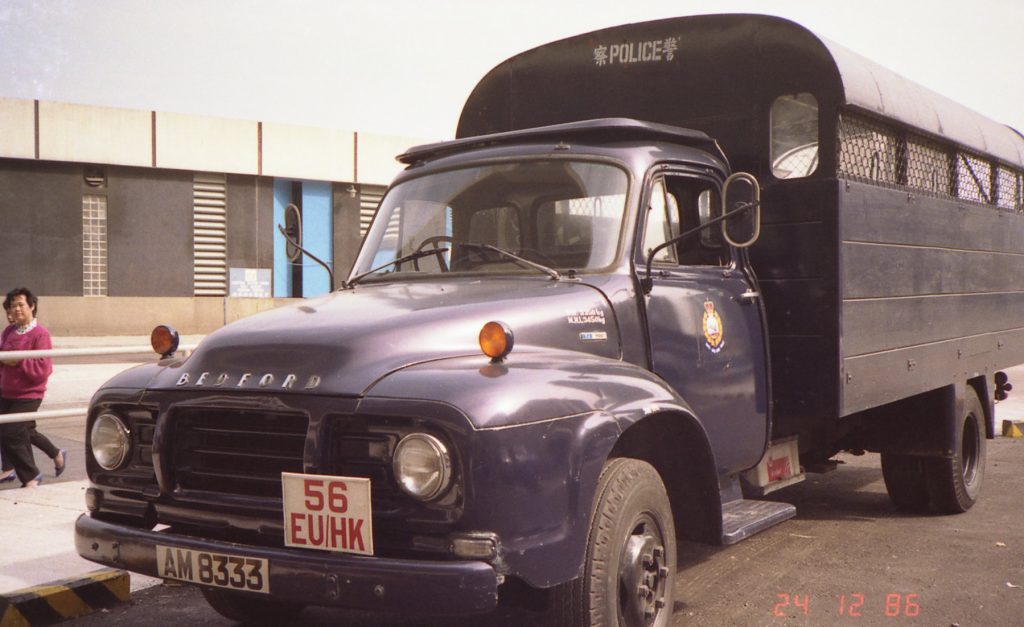
Uniforms made clear the colonial-era HKPF’s nature, being issued in rifle green,[13] and police officers were habitually equipped with firearms.[14] Indeed, from the outset, the HKPF was designed to quickly shift from civil to paramilitary policing for internal security with support from the British Army if needed.[15]
Beyond the general militarisation of the HKPF, specialised units displayed an even more soldierly character.
Following the events of the Munich Olympics, the Marksman Unit was established in Hong Kong, with its officers armed with Sterling submachine guns, AR-15s, and Remington sniper rifles.[16] This unit was then stood down after its successor, the Special Duties Unit, had reached operational capacity in late 1978.[17] When first founded, the SDU was trained by the British Special Air Service and was something of an open secret; widely known by the rank-and-file but referred to initially in official documents simply as “a specialist unit within Operations Wing”.[18] On top of this, when establishing a specialist water team, the SDU was advised by the Royal Navy’s Special Boat Squadron and sent officers to be trained at the Royal Navy diving school in Portsmouth.[19] In a similar vein, the RUC established the E4C intelligence-gathering unit in 1978 that was supported by the Headquarters Mobile Support Unit, itself trained by the SAS as well.[20]
The Small Boat Unit of the Small Boat Division is another such example, with its former commander Les Bird describing it as “a small, elite, maritime unit comprising of one hundred men and a dozen small pursuit craft […] whose primary role was that of marine counter-terrorism.”[21] The wider Marine Police also maintained a militarised image, with many members of the public mistaking it for a unit of the armed forces separate from the police. Of additional interest is the fact that it had originally recruited from soldiers of the Allied intervention against the nascent Russian Soviet Federative Socialist Republic.[22]
In fact, during the 1967 unrest, helicopters were deployed from the aircraft carrier HMS Hermes to support law enforcement operations, raiding leftist strongholds, and after the unrest was quelled the RAF permanently stationed helicopters in Hong Kong.[23] Furthermore, the 1970 edition of the Hong Kong Police Manual of Internal Security suggested that military units should be used in riot suppression to cordon off an area to allow police officers to focus on the respective area.[24] In what could be described as a parody of these tactics, during the 2011 occupation of the Hetherington building in the University of Glasgow, a police helicopter was called in to support over 40 police officers to dislodge students.[25]
The early HKPF was also not above using extra-legal means to punish criminals. Since the beginnings of British colonial rule in Hong Kong, the British would routinely deport Chinese people considered undesirable to the Mainland, with the addition during the era of the Qing dynasty of cutting off the deportees’ braided queues (a mandatory hairstyle under Qing rule) with the intent of subjecting them to further punishment. This would later translate into the deportation of communists to suffer at the hands of the Kuomintang if they did not have the right of abode.[26] This outsourcing of dealers in death has also been seen in Britain’s Irish experiences; members of the Ulster Defence Association received intelligence from the British security services during the Troubles,[27] and bomb disposal experts from the British and Irish armed forces as well as the Garda Síochána have together said that bombings by the Ulster Volunteer Force in Dublin and Monaghan on 17 May 1974 likely occurred with the help of state security services.[28]
In developing riot police methods for the RHKPF, commissioner Roy Henry, a Scotsman who had served in the British Army in Palestine before serving in a number of different colonial police services,[29] drew on his own experiences and those of others in the empire, amalgamating concepts drawn from Malaya, Borneo, Kenya, and Cyprus.[30] In describing the RHKPF’s approach to riot control, Henry described it as “paramilitary”, and sent his Director of Operations Richard Quine to present RHKPF tactics to the Association of Chief Police Officers in 1981. Arguably most significantly, Quine shared a handbook containing all methods and tactics used by the RHKPF in this regard, which would then be used as the basis for the Public Order Manual of Tactical Options and Related Matters,[31] which was rolled out for police forces across Britain to begin training with in late-1983.[32] Material in this document would later be revealed during the Orgreave riot trial in debates on the legality of baton charges.[33] In addition, personnel from British home police forces were also sent to Hong Kong to train with the HKPF starting in 1983 specifically to learn colonial riot control tactics.[34] Indeed, as one trainer of the HKPF’s anti-riot squad noted:
“The anti-riot tactics were ‘home-made’. I could not represent the authority but I do know that we were not copycats. For example, we used what we already had, like rattan shields, which British [sic] did not have. It was Hong Kong that invented the strategy. Actually the research we were doing in Hong Kong had no precedents. Now whenever and wherever there are riots, the Hong Kong police respond in an organised way, which is wholly different from what’s being done in other places.”[35]
The militarisation of police training that could be seen in Hong Kong and Ireland has been adopted in Britain as well, with instructors providing riot training for the Metropolitan Police at Hounslow as early as the 1980s including former SAS personnel and those from other military units.[36] More recently, the Metropolitan Police’s counter-terrorism specialist firearms officers unit is advised and trained by British special forces. Despite National Police Chiefs’ Council Lead for Armed Policing Simon Chesterman’s insistence that “Police forces in the UK do not have a ‘shoot to kill’ policy – armed officers are trained to use as much force as is reasonable in the circumstances,” this hardly comes as much assurance when police officers are trained to shoot to the head. Furthermore, in private conversation, senior officers have noted “that cuts to neighbourhood policing, including a potential reduction in the number of frontline officers, would damage the contacts and trust gained among communities and thus the intelligence gathered.”[37] [38]
The equipment of policing similarly reflects a transmission from the periphery to the core.
In the British Raj, the Punjabi government requested access to tear gas in February 1920, but was rebuffed by the India Office, which released a memo in which it stated the opinion that as “the use of gas in war had been justly condemned by the general opinion of the civilised world, it was impossible for the Government of India to contemplate the employment of similar methods in times of peace for the dispersal of unlawful assemblies.”[39] India was not the only British colony in which colonial authorities desired this new method of riot control, with North Rhodesia being emboldened by the praises of South Africa’s government and requesting 40 tear gas bombs and 50 gas masks in 1930, and Nigeria’s government calling for similar equipment.[40] High Commissioner of Palestine Arthur Wauchope made a request for the use of tear gas in November 1933 and was told that as chemical weapons were banned in war, they could not be deployed in peace. However, after a back and forth, imperial authorities in London succumbed to Wauchope’s persuasions and authorised its use on 20 December 1933, which would result in the rolling out of tear gas across other colonies.[41] By 1965, Britain had developed a new formula for CS gas and between 1962 and 1964 had earned over £10,000 (equivalent to £200,000 in 2017) in sales to Indonesia, Kenya, Malaysia, Hong Kong, Nigeria, Portugal, Singapore, and Rhodesia.[42] Tear gas also saw use in the Battle of the Bogside in Derry.[43]
The lachrymatory invention which had been deployed and used with such zeal across the empire finally returned home on 6 July 1981, when Merseyside police fired CS gas rounds (some directed squarely at protestors caused physical damage) in the primarily black and working-class community of Toxteth, Liverpool.[44] It is noteworthy that Merseyside Chief Constable and then-President of the ACPO Kenneth Oxford wrote the introduction for the Public Order Manual of Tactical Options and Related Matters, in which he specifically made reference to these disorders.[45]
Much as with CS gas, water cannon had also been used during the Battle of the Bogside.[46] However, it saw an initially short history of use, being relegated following the initial stages of the Troubles until its return in 2000 by the PSNI.[47] Notably, proposals for the use of water cannon during the riots across England in 2011 saw support from both Conservative and Labour politicians, with concerns mainly surrounding practicality as opposed to their use itself.[48] Following the riots, then-Mayor of London Boris Johnson purchased three German water cannon in 2014 at a cost of £322,000, bringing this technology to mainland Britain, which were ultimately sold by Sadiq Khan in 2018 for a mere £11,000 after having never been used.[49] Nonetheless, this transfer of technology is another example the militarisation of police and riot control methods coming back around to haunt Britain.
Unfortunately, one thing which does not seem to have come back from the periphery to the core is the inefficacy of internal surveillance. In his role as Deputy Postmaster General of Hong Kong during the early 1980s, David T. K. Wong had a chance encounter with a document dubbed the “Q-list” during the Postmaster General’s annual leave. What followed was an abject story of ineptitude, in which having been given the keys to the Postmaster General’s safe, Wong found and read the Q-list, which had been drawn up by Special Branch and contained names and addresses of those considered political or criminally suspect, as well as some who had value in economic intelligence. In particular, Wong noticed an address ascribed to be the home of billionaire Fok Ying-Tung, but which he knew Fok rarely resided at.[50] Special Branch had not included, on the other hand, the home of Fok’s second wife, and Wong could not find an address that seemed a likely candidate for the home of Fok’s third wife on the list.[51] As if not embarrassing enough, the entire operation had to be scrapped in 1982 after workers at the General Post Office complained of discrimination having heard of the “night shifts” that certain workers had been offered; in reality, they had accidentally stumbled upon the mechanism by which Special Branch had been secretly reading postal correspondence.[52]
Nevertheless, whilst the “skill” level of spy-craft has not been transferred, the model of such surveillance has. Indeed, one of the points Roy Henry focused on when advising the ACPO in 1981 was the need for a special branch.[53] Debates from the second reading of the Interception Of Communications Bill similarly note in Britain the “institutional relationship between the police, the CID or the special branch and the Post Office—subsequently British Telecom”.[54] Indeed, former Communist Party General Secretary comrade Robert Griffiths noted in ‘The Gleam of Socialism’ that through the 1950s to 1970s, MI5 maintained a constant roster of at least 60 officers headquartered in London tasked with surveilling and disrupting the CPGB, with more in the field,[55] as well as giving numerous examples of individual comrades being put under the scrutiny of the intelligence services, including Special Branch. In addition to the plethora of records that have since become available, former MI5 officer Annie Machon revealed that from 1952 “MI5 and subsequent governments used to argue that all members of certain parties – such as the Communist Party of Great Britain […] were threats to the security of the state or our democratic system. This in itself is a contentious proposition.”[56]
As such, on top of militarisation of the police, Britain stands as one of the most surveilled states in the world. For every 10,000 people there are 617.77 CCTV cameras, with London having some 690,923 or roughly one for every 13 residents, a total more than many European countries and equivalent to Germany or France.[57] Home Secretary Shabana Mahmood has also announced plans that will see the creation of a national centre on artificial intelligence to oversee a nationwide fleet of vans using live facial recognition technology, a major rollout of such technology in England and Wales, and investment of £115 million in AI and automation for the police. In addition to these technological developments, she also proposed the creation of a new National Police Service (NPS) dubbed the “British FBI”,[58] an act which would only further degrade local control over law enforcement.
Beyond the worries surrounding the British state’s use of technology in police-related surveillance, the nature of the companies involved in the development and sale of such technology is a major cause for concern. Following a recent Twitter post in which our Party criticised the role of Palantir and other technology monopolists following Palantir’s founder Joe Lonsdale quote retweeting a post which called for communists to be “blown up”,[59] Lonsdale stepped in to spat and recycled old anti-communist Cold War narratives. Just as revealingly, numerous right-wing keyboard warriors stepped in to completely derail Lonsdale’s claims of standing for “freedom and civil liberties” by calling exactly for the killing of communists,[60] essentially outing themselves to the public in a perfect example of quod est demonstratum.
CCTV also reveals the cross pollination which occurs in colonial “best” practice. The Gaza Genocide Emergency Committee noted in 2024 the intertwining of Glasgow City Council with the fruits of the Israeli state’s genocidal practices in Palestine, with the city’s local government making use of military grade “emotional recognition” surveillance technology provided by NICE Limited, owned by Elbit Systems. NICE later sold this section of its portfolio to Qognify, another Israeli company, and Glasgow City Council signed a contract with another Qognify-owned company, CGI. GGEC also brought to the fore the fact that NICE had been founded by seven former members of Israel’s Unit 8200 which had been known to extort informants using information gathered on sexual preferences and health issues,[61] a blatant violation of privacy, or if one were somehow more concerned with procedure then GDPR.
The use of CCTV footage was noted in the “spy cops” scandal, with the Special Demonstration Squad having had access to London’s CCTV cameras in the 1990s.[62] The story of the SDS and its monstrous effects on British citizens’ personal lives has been documented elsewhere, but it should go without saying that undercover police of this nature betray the Peelian principle of uniformed law enforcement and show a wider shift of police becoming spies or otherwise something else than the benevolent Bobby which they wished the public thought of them as.
Our Party released a statement on 26 January following the public murders conducted by ICE in the United States noting that Nigel Farage’s push for the deportation of 600,000 migrants and the call of Trump supporters in Britain to create a British ICE “necessarily imply paramilitary policing of Britain’s towns and cities and the physical suppression of civilian populations.” Additionally, in its 2026 manifesto, the Scottish Police Federation has proposed “equipping every officer with a Taser and adopting the Norwegian/New Zealand firearms model in which all officers are trained and firearms are stored in vehicles”, with these proposals to be put forward to MSPs in February.[63] This follows a trend both in Scotland, in which a 2021 poll showed that more than half of Scottish police officers wished to be armed with guns, and globally, with the vast majority of countries having law enforcement personnel being routinely armed.[64]
Whilst we would hardly call Peel or his model a paramount of people’s policing, the growing openness of the repressive elements of law enforcement in the Western liberal democracies generally and Britain specifically are unmasking the myth of “policing by consent”. Frankly, when even senior police officers in the country have been warning for decades against the shift in how law enforcement is conducted, the proverbial canary in the coal mine is no longer singing; it is shrieking and on the verge of passing out. It is worth quoting Waddington, who in 1991 wrote that “there seems no reason to suppose that a government that possessed the constitutional power to instruct the police overtly would retreat from doing so, any more than Mrs Thatcher’s Government shrank from covertly using what power and influence it had.”[65]Additionally, the multitude examples above show that from Palestine to Merseyside, from Derry to London, the struggle of the working class against the machinery of the dictatorship of the bourgeoisie is one. The question is exceedingly less of “how long” until colonial policing boomerangs back to the metropole, but “how often”.
Ethan Chan, is International Officer of the Young Communist League
[1] Gerry Northam, Shooting in the Dark: Riot Police in Britain (London: Faber and Faber Limited, 1988), 29–30.
[2] Clive Emsley, “The birth and development of the police,” in Handbook of Policing, 2nd ed., ed. Tim Newburn, (Uffculme: Willan Publishing, 2008), 74.
[3] P. A. J. Waddington, The Strong Arm of the Law: Armed and Public Order Policing (Oxford: Claringdon Press, 1991), 4–5.
[4] Northam, Shooting in the Dark, 127–128.
[5] Emsley, “The birth and development of the police,” 76.
[6] Ibid, 78–79.
[7] Patricia O’Sullivan, Policing Hong Kong – An Irish History: Irishmen in the Hong Kong Police Force 1864-1950 (Hong Kong: Blacksmith Books, 2017), 136.
[8] Ibid, 165.
[9] Kam C. Wong, Policing in Hong Kong: History and Reform (Boca Raton, FL: CRC Press, 2015), 233.
[10] Hong Kong Police Force 175th Anniversary – From Strength to Strength: Serving with Pride and Care (Hong Kong: Hong Kong Police Force, 2019), 190.
[11] Lawrence Ka-ki Ho, Y. K. Chu, Henry Ming-sun Ho, Without Fear or Favour: Illustrated History of the Hong Kong Police, trans. Gordon K. Chung (Hong Kong: The Commercial Press (H.K.) Ltd., 2016), 11.
[12] Kenneth Lesley-Dixon, Northern Ireland – The Troubles: From the Provos to the Det, 1968-1998 (Barnsley: Pen and Sword Military, 2018), 77.
[13] Ho, Chu, and Ho, Without Fear or Favour, 161.
[14] Ibid, 4.
[15] Lawrence Ka-ki Ho, “Rethinking police legitimacy in postcolonial Hong Kong: Paramilitary policing in protest management,” Policing 14, no. 4 (2020), 1017.
[16] Bill Duncanson, “Marksman Unit 1973–1978,” in Stories from the Royal Hong Kong Police: Fifty accounts from officers of Hong Kong’s colonial era police force (Hong Kong: Blacksmith Books, 2020), 174–175.
[17] Ibid, 187.
[18] Chris Emmett, Hong Kong Police: Inside the Lines (Hong Kong: Earnshaw Books Ltd., 2018), 183–184, 186.
[19] Sandy Macalister, “Special Duties Unit – Water Team,” in Stories from the Royal Hong Kong Police: Fifty accounts from officers of Hong Kong’s colonial era police force (Hong Kong: Blacksmith Books, 2020), 233.
[20] Lesley-Dixon, Northern Ireland – The Troubles, 80.
[21] Les Bird, A Small Band of Men: An Englishman’s Adventures in Hong Kong’s Marine Police (Hong Kong: Earnshaw Books Ltd., 2019), 215.
[22] Ho, Chu, and Ho, Without Fear or Favour, 19.
[23] Kwong Chi Man and Tsoi Yiu Lun, Eastern Fortress: A Military History of Hong Kong, 1840–1970 (Hong Kong: Hong Kong University Press, 2014), 258–259.
[24] Lawrence K.K. Ho and Yiu Kong Chu, Policing Hong Kong 1842 – 1969: Insiders’ Stories (Hong Kong: City University of Hong Kong Press, 2012), 95.
[25] “Glasgow University principal ‘regrets’ campus unrest,” BBC News, March 24, 2011, https://www.bbc.co.uk/news/uk-scotland-glasgow-west-12850573.
[26] Steve Tsang, A Modern History of Hong Kong (Hong Kong: Hong Kong University Press, 2004), 47–48, 104.
[27] Lesley-Dixon, Northern Ireland – The Troubles, 49.
[28] Ibid, 62–65.
[29] “Remembering Roy,” Offbeat Online, June 9, 1998, https://www.police.gov.hk/offbeat/632/features.html.
[30] Northam, Shooting in the Dark, 135.
[31] Ibid, 39–41.
[32] Ibid, 46.
[33] Waddington, The Strong Arm of the Law, 167.
[34] Northam, Shooting in the Dark, 134.
[35] Ho and Chu, Policing Hong Kong 1842 – 1969, 95.
[36] Ibid, 169.
[37] “NPCC Lead for Armed Policing has said he is confident in the ability of firearms officers to protect the public,” National Police Chiefs’ Council, November 18, 2015, https://news.npcc.police.uk/releases/national-police-chiefs-council-lead-for-armed-policing-has-said-he-is-confident-in-the-ability-of-firearms-officers-to-protect-the-public.
[38] Vikram Dodd, “Scotland Yard creates SAS-style unit to counter threat of terrorist gun attack,” The Guardian, June 29, 2015, https://www.theguardian.com/uk-news/2015/jun/29/scotland-yard-creates-sas-style-unit-to-counter-threat-of-terrorist-gun-attack.
[39] Anna Feigenbaum, Tear Gas: From the Battlefields of World War I to the Streets of Today (London: Verso, 2017), 47.
[40] Ibid, 54–55.
[41] Ibid, 57–60.
[42] Ibid, 67.
[43] Ibid, 103.
[44] Ibid, 123.
[45] Northam, Shooting in the Dark, 42.
[46] Lesley-Dixon, Northern Ireland – The Troubles, 78.
[47] Michael McHugh, “Historic police water cannon up for sale,” Belfast Telegraph, February 14, 2021, https://www.belfasttelegraph.co.uk/news/northern-ireland/historic-police-water-cannon-up-for-sale/40091720.html.
[48] Stephen Bates, “Use of water cannon on rioters backed across political divide,” The Guardian, August 9, 2011, https://www.theguardian.com/uk/2011/aug/09/theresa-may-water-cannon-riots.
[49] “Boris Johnson’s unused water cannon sold for scrap at £300k loss,” BBC News, November 19, 2018, https://www.bbc.co.uk/news/uk-england-london-46258584.
[50] David T. K. Wong, Hong Kong Confidential: Life as a Subversive (Hong Kong: Blacksmith Books, 2018), 474–476.
[51] Ibid, 482.
[52] Ibid, 488.
[53] Northam, Shooting in the Dark, 77.
[54] HC Deb 12 March 1985, vol 75, col 210.
[55] Robert Griffiths, ‘The Gleam of Socialism’: Britain’s Communist Party 1920-2020 (Glasgow: Praxis Press, 2024), 236.
[56] Rob Evans and Paul Lewis, Undercover: The True Story of Britain’s Secret Police (London: Guardian Books, 2014), 145.
[57] “Is the UK the Most Surveilled Country in the World? Global Rankings,” eufy, December 10, 2025, https://www.eufy.com/uk/blogs/security-camera/is-the-uk-heavily-surveilled.
[58] “Live facial recognition tech to be rolled out across Britain,” Morning Star, January 26, 2026, https://morningstaronline.co.uk/article/live-facial-recognition-tech-be-rolled-out-across-britain.
[59] MintPress News, “Palantir co-founder Joe Lonsdale has made highly controversial public statements regarding the company’s origins following the political upheaval in Venezuela and the kidnap of Nicolás,” Facebook, January 8, 2026, https://www.facebook.com/MintpressNews/photos/palantir-co-founder-joe-lonsdale-has-made-highly-controversial-public-statements/1175882298073406/.
[60] @CPBritain, “Founder of the Palantir AI firm (who the UK government have recently signed contracts worth billions with) saying the quiet part out loud. The US tech monopolies want control and subjugation,” Twitter, January 6, 2026, 21:29, https://x.com/CPBritain/status/2008652183093604789.
[61] “Israeli Military Grade Surveillance System is Monitoring Glasgow City Centre,” Gaza Genocide Emergency Committee, April 8, 2024, https://ggec.org.uk/israeli-military-grade-surveillance-system-is-monitoring-glasgow-city-centre/.
[62] Evans and Lewis, Undercover, 145.
[63] Xander Elliards, “Police Scotland officers lobby MSPs for guns on duty,” The National, January 14, 2026, https://www.thenational.scot/news/25766596.police-scotland-officers-seek-political-support-guns-duty/.
[64] “Police Scotland: Shock poll showing many officers want access to firearms is a worrying sign for society – Scotsman comment,” The Scotsman, September 7, 2021, https://www.scotsman.com/news/opinion/columnists/shock-poll-on-police-firearms-is-a-worrying-sign-for-scotland-scotsman-comment-3373107.
[65] Waddington, The Strong Arm of the Law, 267.