
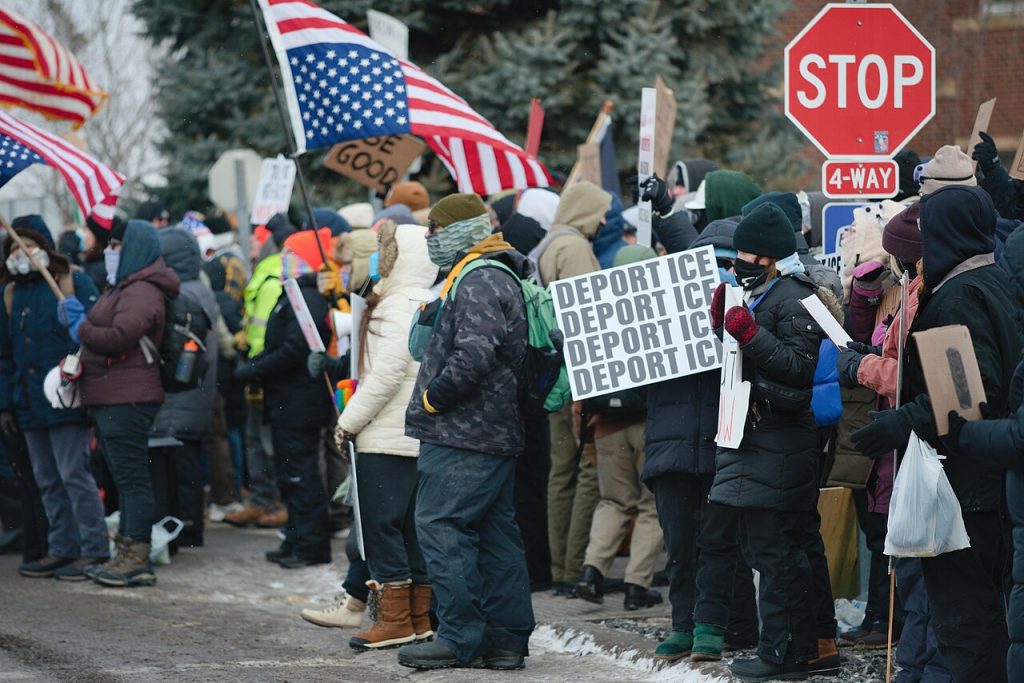
On the surface, the recent confrontations around Immigration and Customs Enforcement (ICE) appear as another episode in a familiar American cycle: a flash of state violence, public outrage, protests, official denials, and a rapid attempt by political institutions to contain the fallout. But this moment cannot be understood as a rupture or aberration. It is the predictable expression of an enforcement regime deliberately constructed over decades, sustained by bipartisan consensus, and insulated from meaningful democratic control. ICE is not an accidental institution that went wrong. It was designed this way.
The Birth of ICE and the Security Turn
ICE emerged in 2003, in the shadow of the September 11 attacks, as part of the newly formed Department of Homeland Security. Its creation reflected a decisive shift in U.S. governance: the fusion of immigration control with national security. Migration, once framed primarily as a labor and civil issue, was redefined as a threat vector. This reframing justified extraordinary powers, expansive surveillance, and a culture of enforcement that borrowed heavily from counterterrorism and policing models.
From the beginning, ICE combined two volatile functions: the pursuit of undocumented migrants within the interior of the country, and the policing of transnational flows of people, money, and goods. The agency inherited personnel, practices, and institutional attitudes from customs enforcement and border policing, then embedded them into a post-9/11 security bureaucracy that rewarded aggression and secrecy. Accountability mechanisms were weak by design. Oversight was fragmented. Legal shields were strong. The result was an agency structurally inclined toward coercion, not service; force, not mediation.
Normalisation Through Bipartisanship
While ICE became a public villain during the Trump years, its expansion was not uniquely Republican. Deportations accelerated under Democratic administrations as well, particularly during the Obama presidency, when removal numbers reached historic highs. This was not a contradiction but a strategy: Democrats sought to neutralise immigration as a political vulnerability by demonstrating “toughness,” while promising reform that never fully materialised.
This pattern mattered. By accepting ICE as a legitimate and permanent institution, Democrats helped normalise its role, even as they criticised its excesses. Calls for reform focused on procedure rather than purpose, on training rather than mission (Congressional debates on ICE reform: https://www.congress.gov). The underlying premise, that a heavily armed federal agency should police civilian populations on the basis of immigration status was rarely challenged at the institutional level.
When abolitionist language briefly entered mainstream discourse after 2016, it was largely symbolic. No serious legislative pathway followed. Funding continued. Authorities expanded. Cooperation with local law enforcement, data brokers, and private detention contractors deepened (ICE budget and contracts: https://www.ice.gov/foia/library). In practice, ICE was allowed to persist as an entrenched pillar of the security state.
This continuity explains why moments of crisis keep recurring. The system has not drifted; it has been maintained.
Scope and Legal Framework of ICE Detention
ICE detains tens of thousands in the U.S., mostly in private, local, or contract facilities. Many detainees lack criminal records, highlighting administrative detention. ICE must follow National Detention Standards, which govern treatment, medical care, and prohibit sexual abuse, outlining reporting procedures and protections for handling allegations of abuse and assault. In 2025 ICE updated its National Detention Standards to replace “gender” with “sex,” focusing policies on biological categories. Because these rules disregard gender identity, they often fail to recognise or protect transgender, nonbinary, intersex, and other gender‑diverse people, effectively side-lining their safety and needs in detention without meaningful accountability.
Investigations and reports indicate systemic issues in ICE detention facilities, including unsafe living conditions, poor medical care, and mistreatment of detainees. Reports document negligent healthcare, unsanitary conditions, racial bias, isolation for minor infractions, solitary confinement, and denial of care for chronic illnesses. Overcrowding, inadequate food and water, restricted legal or family access, and delayed medical attention have been reported nationwide. Emergency call data, 911, also indicate spikes in serious medical incidents, self-harm, and sexual abuse allegations (GBH) (ICIJ).
Specific Allegations of Sexual Abuse and Retaliation
Historical records show repeated ICE staff abuse. At Louisiana’s South Louisiana ICE Processing Centre, a guard pleaded guilty to sexually abusing a detained Nicaraguan woman over several months, violating federal law. Despite Prison Rape Elimination Act (PREA) requirements, investigations show ICE’s reporting and oversight systems frequently fail to document or fully investigate abuse. Cases where guards were charged or sentenced span the country, including Texas, Florida, New York, California and Washington State.
In California, before a hearing of the National Prison Rape Elimination Commission in December 2006, Esmeralda Soto described being sexually assaulted as a transgender woman while detained in 2003 at San Pedro, saying a guard forced her to perform oral sex, left briefly, then returned and compelled her to repeat the act.
Five women detained at the Port Isabel Service Processing Center in Texas were assaulted in 2008 when then-guard Robert Luis Loya entered each of their rooms in the detention center infirmary, where they were patients ordered them to undress, and touched intimate parts of their bodies. In 2007, an ICE agent raped a detainee while transporting her in Florida; he was fired and, in 2008, Wilfredo Vazquez was sentenced to over seven years for sexual abuse.
Two detainees at Tacoma’s Northwest Detention Center, Washington reported sexual harassment, including a guard asking about sexual activity and another rubbing a detainee’s buttocks to “wake him up.” A 2008 Seattle University OneAmerica report documented five invasive strip searches after attorney visits; one female detainee said, “Here we were stripped completely naked. A female officer told me to open my legs wide and she peeped into my vagina and later, she asked me to turn my back-side and expose my anus [by separating the cheeks with her hands], I was told to cough several times while in this position, with the officer looking at my private parts. We were forced to subject ourselves to this dehumanizing treatment.”
In 2006, Lydia S., an ICE detainee in Arizona, was forced to undergo a strip search after criminal prisoners were moved into her dorm. Guards ordered women to strip, circle, bend, and cough. The degrading search traumatised her, silencing complaints and leaving lasting psychological harm.
Medical Neglect, Deaths in Custody, and Accountability Failures
Reports describe medical neglect in ICE custody, including shackling pregnant women, delayed prenatal care, poor nutrition, and inadequate treatment for serious illnesses. Deaths have intensified scrutiny, with a recent death at Camp East Montana (an ICE detention facility at Fort Bliss, Texas) was officially classified as a homicide by an autopsy report, raising serious questions about the circumstances of restraint by guards. Last year, ICE custody saw one of the highest numbers of detainee deaths in decades, indicating persistent safety and oversight issues.
ICE detention relies heavily on private, local, and subcontracted facilities where updated sexual-abuse rules often do not take effect until contracts are renewed, sometimes years later. Investigations reveal that many abuse allegations are not properly reported to DHS and often go uninvestigated. Official records show at least 308 sexual assault and abuse complaints were filed from 2015 to 2021 across ICE facilities, with more than half directed at staff, yet a minority trigger meaningful action, exposing systemic oversight failures and weak accountability.(U.S. Immigration and Customs Enforcement) (Futuro Investigates). (Just Detention International)
Enforcement as Social Control
ICE functions beyond immigration enforcement as a tool of labour discipline and social control, where the threat of detention suppresses wages, discourages organising, and fractures working-class solidarity. For the CPUSA, the recent killings and enforcement actions are cases of state violence that must be responded to with grassroots resistance, building community-labour alliances, and demands for federal accountability.
Discussing resistance to ICE in Minneapolis, our American comrades highlight the importance of participation in mass protests, state-wide mobilisations, and coordinated efforts to build coalitions among labour unions, community groups, and immigrant rights organisations opposing ICE operations. The latest ICE attacks on these communities are nothing new: they reflect longstanding state violence against working-class and immigrant communities, not isolated failures. These visible incidents of use of force expose the everyday coercion embedded in detention, raids, and deportations.
The Politics of Calling Immigrants “Aliens”
Over the past decade, migration labels – “migrant,” “refugee,” “illegal,” “alien” – have been used politically to shape sympathy, legal rights, and exclusion. Research shows framing affects support, with “refugees” receiving more protection. Labels impose moral hierarchies, reflecting bias, while terms like “forced migrant” expose language’s limits; naming determines who is recognised as human, protected, and whose suffering is administratively tolerated.
In the United States, alienage became a vehicle for exclusion. The Alien Enemies Act of 1798, Chinese Exclusion laws, and later the Immigration and Nationality Act embedded “alien” into a legal architecture that normalised collective suspicion, plenary congressional power, and minimal judicial review. Alienage justified internment, deportation, denaturalisation, and even the suspension of citizenship rights, as seen most starkly in Japanese internment and the stripping of citizenship from Asian Americans in the early twentieth century. The term allowed the state to treat certain groups as permanently outside the political community, regardless of residence, contribution, or citizenship.
Australia’s “aliens’ power” enabled racialised exclusion so broad that courts in 2020 debated whether Indigenous Australians were “aliens.” The UK instead excluded through citizenship rules, not alienage. This history shows “alien” is unnecessary in modern law; New Zealand and Canada have removed it without impairing immigration systems.
The Limits of Reform
Each crisis renews calls for better training, clearer rules of engagement, or stronger civilian review. These proposals assume that ICE’s core mission is sound and that harm results from deviation or misconduct. History suggests otherwise. An institution built to criminalise existence cannot be humanised through managerial tweaks.
Democratic complicity stems from structural accommodation, not bad faith; by accepting the post‑9/11 security framework, liberal politics limited itself to damage control, leaving ICE powerful, legally shielded, culturally insulated, and public trust declining amid rising confrontations.
Abolitionist arguments challenge this logic directly. They do not ask how ICE can operate more gently, but why it exists at all in its current form. They propose replacing enforcement with civil immigration systems, labour protections, and international cooperation that address displacement at its source. These are political choices, not technical fixes.
A Predictable Outcome
The current moment reveals volatile tensions as ICE’s coercive enforcement clashes with resistant communities, exposing the security state’s personal, violent impact.
These processes are not isolated to American soil: hard-line immigration language and tactics — detention first, rights later — have been echoed in UK political debate. What is taking place is the systematic dehumanisation of people whose labour those same economies depend on. In the name of ‘America First’ and ‘UK citizens first’ what they are doing is just dehumanising the people their own country profit from – the people they get low-cost labour from. Still, only British nationals would be permitted recourse to public funds. Not the immigrants who equally work night and day and support these countries economy as well. Coming for the legal migrants is just absurd. With Nigel Farage’s own ICE, Reform UK, backing elimination of Indefinite Leave to Remain, Human Rights Act repeal, and ECHR withdrawal, we risk severe rights erosion, and the export of an ICE‑like enforcement ethos that normalises dehumanising practices internationally.
Until that logic is confronted at its root, the cycle will continue. New incidents will replace old ones. Official statements will promise restraint. Protests will flare and fade. The structure, intact and well-funded, will carry on doing what it was built to do.
Shaila Shobnam, is a member of the YCL’s London Branch