This statement has been republished in full in Challenge
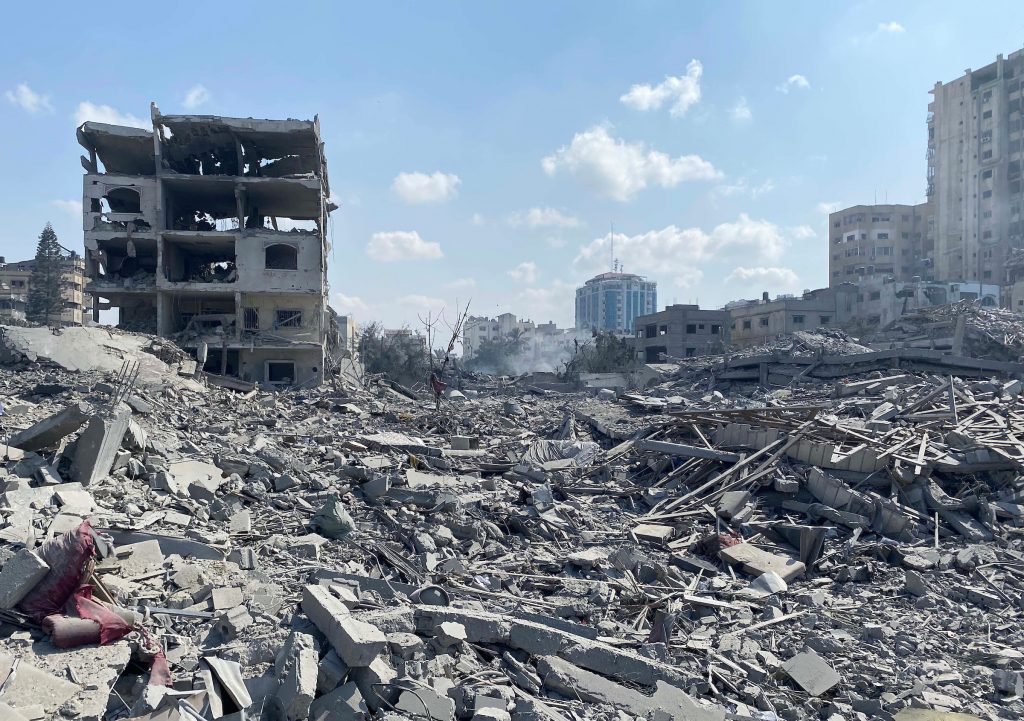
After more than two years of genocidal war that devastated the Gaza Strip and claimed tens of thousands of lives, a new agreement has been announced to halt the war between the Israeli occupation and Hamas, under joint American–Qatari–Egyptian–Turkish sponsorship.
Although the agreement appears, on the surface, to be a humanitarian response to end the catastrophe, its political content and timing indicate a profound shift in the management of the Palestinian–Israeli conflict — not its conclusion.
1. An Agreement of Necessity, Not of Will
The circumstances under which the agreement was reached reveal that it is born of necessity rather than a genuine political will. The Israeli occupation finds itself mired in an unprecedented military and moral crisis, having failed to achieve its declared strategic objectives of eliminating Hamas or imposing an “alternative security regime” in Gaza. Meanwhile, its government faces growing international isolation and internal pressure demanding an end to the war and the return of captives.
As for Hamas, despite its military resilience, it has endured massive human and material losses and a catastrophic humanitarian reality, necessitating a pause to regroup and restore internal cohesion. Thus, the agreement emerged as a temporary settlement that allows each side to claim partial victory without suffering an official defeat.
2. The Prisoner Exchange and Withdrawal Equation: Between Symbolic Victory and the Limits of the Possible
The agreement stipulates the release of more than 2,000 Palestinian prisoners in exchange for 20 Israeli captives alive, along with a gradual exchange of bodies and a synchronized Israeli withdrawal from city centers. This equation shows that the prisoners’ issue has once again become a political lever for the Palestinian resistance. Yet it also entrenches Israeli control over the implementation timetable, leaving wide room for maneuvering and delay.
Moreover, the occupation’s condition of releasing the captives before a full withdrawal aims to neutralize Hamas’s most significant bargaining chip and turn the agreement into a phased process under American and Egyptian supervision.
3. The American Dimension – Trump Returns Through the Gaza Gateway
This development cannot be separated from the American electoral context and Donald Trump’s return to the global political stage. His announcement of the “first phase of a peace plan” falls within the framework of showcasing his leadership on the Middle East file and portraying himself as a “strong peacemaker” ahead of domestic milestones in Washington.
What stands out in the plan, however, is the establishment of a “Peace Council” headed by Trump and Tony Blair to manage Gaza after the war — a concept that resurrects the model of international trusteeship long rejected by Palestinians. It transforms Gaza from a space of resistance into an internationally monitored entity — closer to a laboratory for conflict management than a nucleus for an independent state.
4. Regional Guarantees: Between Containing the Fire and Preserving Influence
The four-way mediation (United States, Egypt, Qatar, Turkey) reflects delicate regional balances. Cairo seeks to reclaim its central role in the Palestinian file, while Doha and Ankara attempt to balance support for the resistance with engagement in postwar arrangements. Yet the so-called “guarantee of no return to war” remains practically fragile, as no binding mechanism exists to ensure the occupation’s compliance or to prevent its habitual field violations.
5. Gaza’s Future: Absence of Vision and the Illusion of the ‘Day After‘
The most dangerous aspect of the agreement is its failure to define who will govern Gaza after the war. The talk of a Palestinian technocratic government under the supervision of the Palestinian Authority seems more like a cosmetic arrangement meant to reassure the West than a real solution to the crisis. Hamas, while expressing readiness to step back administratively, rejects any foreign or political guardianship, whereas Israel refuses any form of governance that includes the resistance. The likely outcome: a temporary political vacuum filled by international security arrangements that may prolong the period of trusteeship rather than end it.
6. Between Truce and Liquidation
Despite the cautious optimism accompanying the announcement, Palestinians understand that truces are often used to impose new realities on the ground. The American discourse about “disarming Hamas” and “gradual withdrawal” suggests that the truce is not the end of the war, but rather a transitional stage for re-engineering Gaza politically and security-wise. In other words, the truce could mark the beginning of a new phase of conflict — one fought with different tools, over who controls decision-making in Gaza, not merely who halts the fighting.
Conclusion: Peace Without Justice Is Only a Postponed Explosion
The Gaza Agreement represents a significant turning point in the course of the war, yet it falls short of a just political solution. Unless the right of the Palestinian people to liberation and self-determination is recognized, any “lasting peace” will remain ink on paper. The real equation is not between war and ceasefire, but between peace grounded in justice and a “temporary truce” that sustains the occupation through softer means.
The guns may fall silent for now, but the roots of the conflict — occupation, settlement, and siege — remain unchanged, awaiting the next round of a struggle that has not truly ended, only changed its form.
Fouad Baker is a member of the DFLP